Angkor Wat
Siem Reap, Cambodia
អង្គរវត្ត
The world's largest religious complex, at the heart of the Khmer capital of Angkor.
Checked 6 October 2026
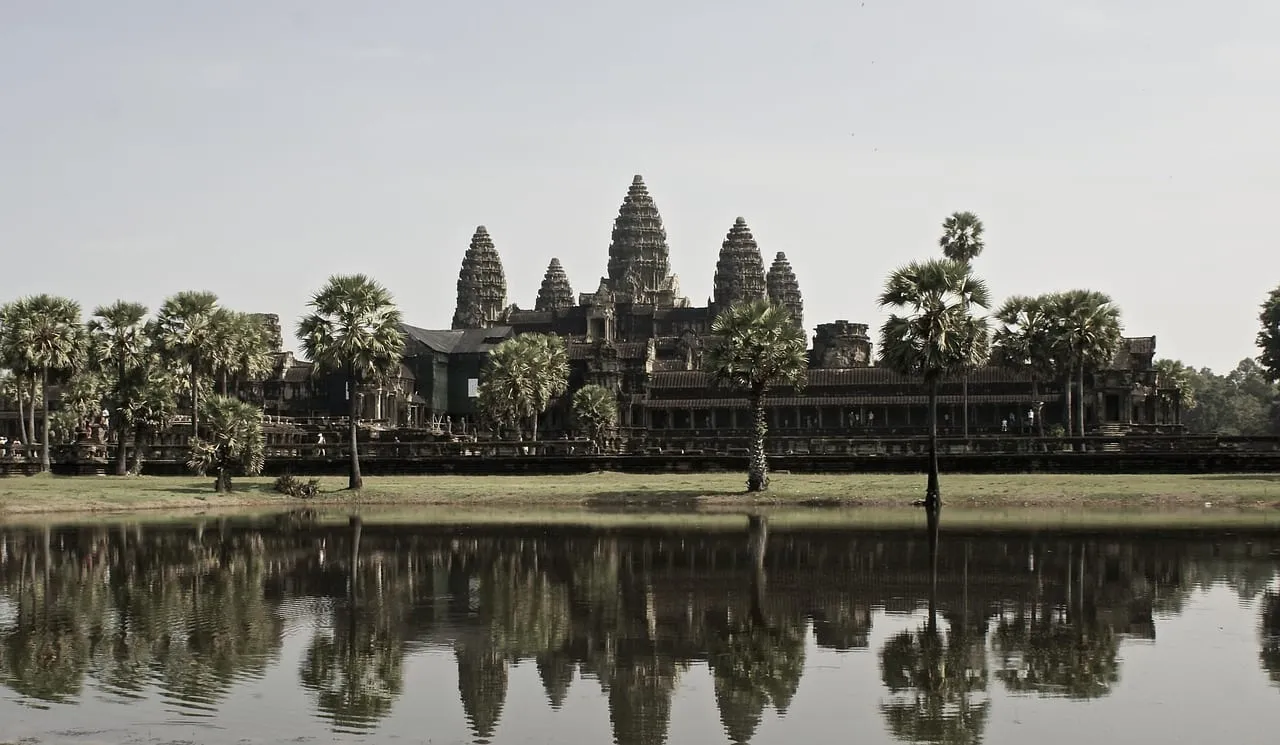
Angkor Wat is the 12th-century temple-mountain at the centre of the Angkor Archaeological Park, a few kilometres north of Siem Reap, with the Bayon, Ta Prohm and dozens more temples around it. You need an Angkor Pass ($37 for one day, $62 for three, $72 for seven), and the only valid seller is the government's Angkor Enterprise: online at angkorenterprise.gov.kh, in its app, or at the ticket office on Road 60. Buy online the day before, after 16:45, and the same pass also gets you in for that evening's sunset.
About Angkor Wat
Angkor Wat stands on a 162-hectare site inside Angkor, the medieval capital of the Khmer Empire, just north of the modern town of Siem Reap. King Suryavarman II built it between about 1113 and 1150 as a Hindu temple to Vishnu and, most likely, as his own mausoleum. It is the largest religious complex in the world and the symbol on Cambodia's national flag.
The temple is a stone model of the Hindu cosmos: a broad moat for the oceans, an outer wall, and three rising galleries leading to five towers in a quincunx that stand for the peaks of Mount Meru. Unusually for Angkor, it faces west. The lower gallery carries hundreds of metres of bas-reliefs, from the battles of the Ramayana and Mahabharata to Suryavarman's army and the Churning of the Sea of Milk.
From the late 13th century Angkor Wat became a Theravada Buddhist temple and it never stopped being used, which is one reason it survived better than the temples around it. Monks still live here and Cambodians still come to pray, so the dress code is real and the top tier closes on holy days.
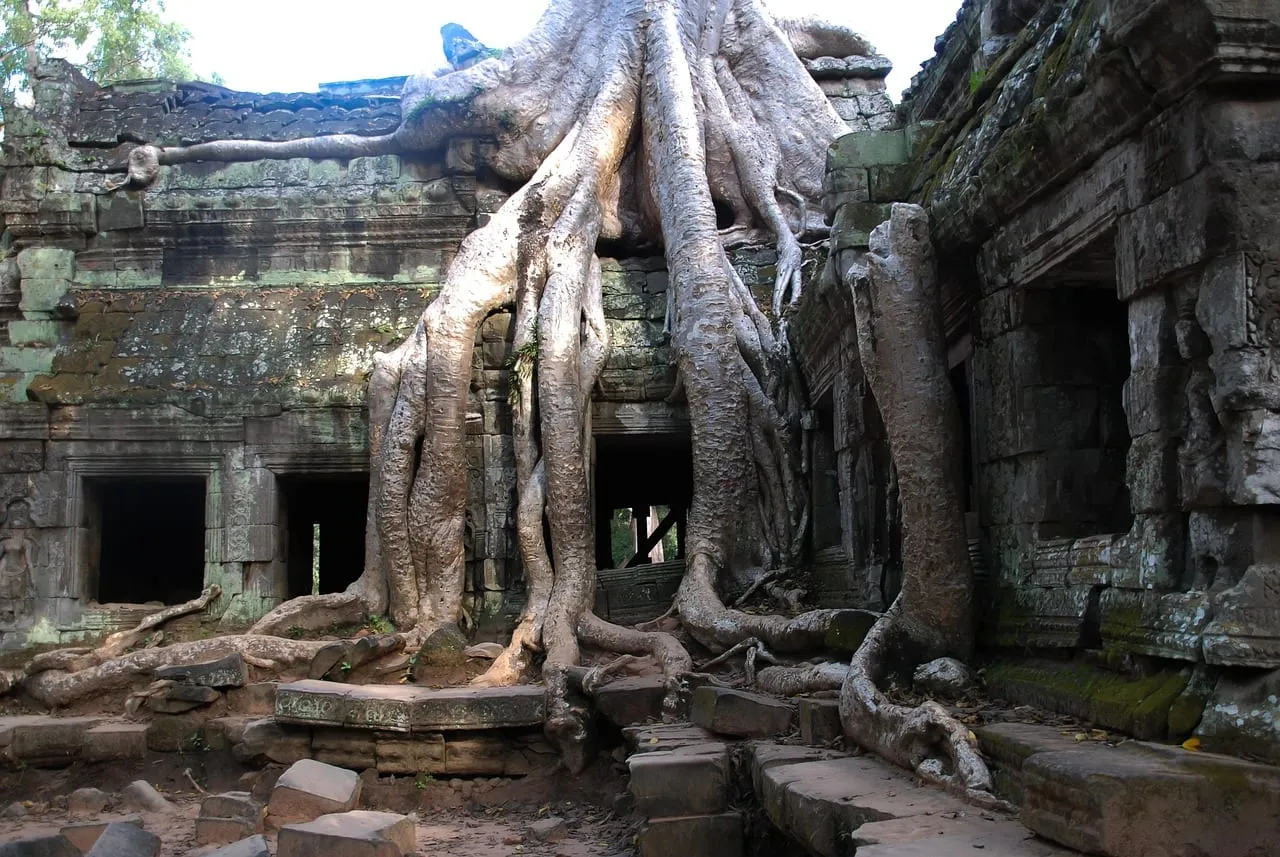
Portuguese friars described the temple in the 1580s, but it was the French naturalist Henri Mouhot's posthumous travel notes of 1864 that made it famous in the West. Angkor became a UNESCO World Heritage Site in 1992. Around it lie the walled city of Angkor Thom with the face towers of the Bayon, the tree-strangled ruins of Ta Prohm and more than 50 other temples covered by the same pass.
What to see
The bas-relief galleries
The outer gallery of Angkor Wat is lined with carved scenes; walk it anticlockwise from the west side to follow the Ramayana and Mahabharata battles, Suryavarman II's army, the judgement of Yama and the Churning of the Sea of Milk. Late morning, when tour groups are elsewhere, is the calm time.
The Bakan (upper level of Angkor Wat)
The central tier with the five towers is reached by a steep wooden staircase with a handrail on the east side; the other stairways are closed. Shoulders and knees must be covered (a scarf does not count) and under 12s may not go up (Angkor Enterprise FAQ). Local operators say it keeps shorter hours than the rest of the temple, roughly 7:40–17:00, and shuts on Buddhist holy days, which follow the lunar calendar; these times are not published officially.
Sunrise over the west pools
The sun rises behind the towers, so you watch from the reflecting pools inside the west entrance. Gates open at 5:00 and first light is around 5:30–5:45. The north pool (left as you walk in) is usually less packed than the south pool.
The Bayon in Angkor Thom
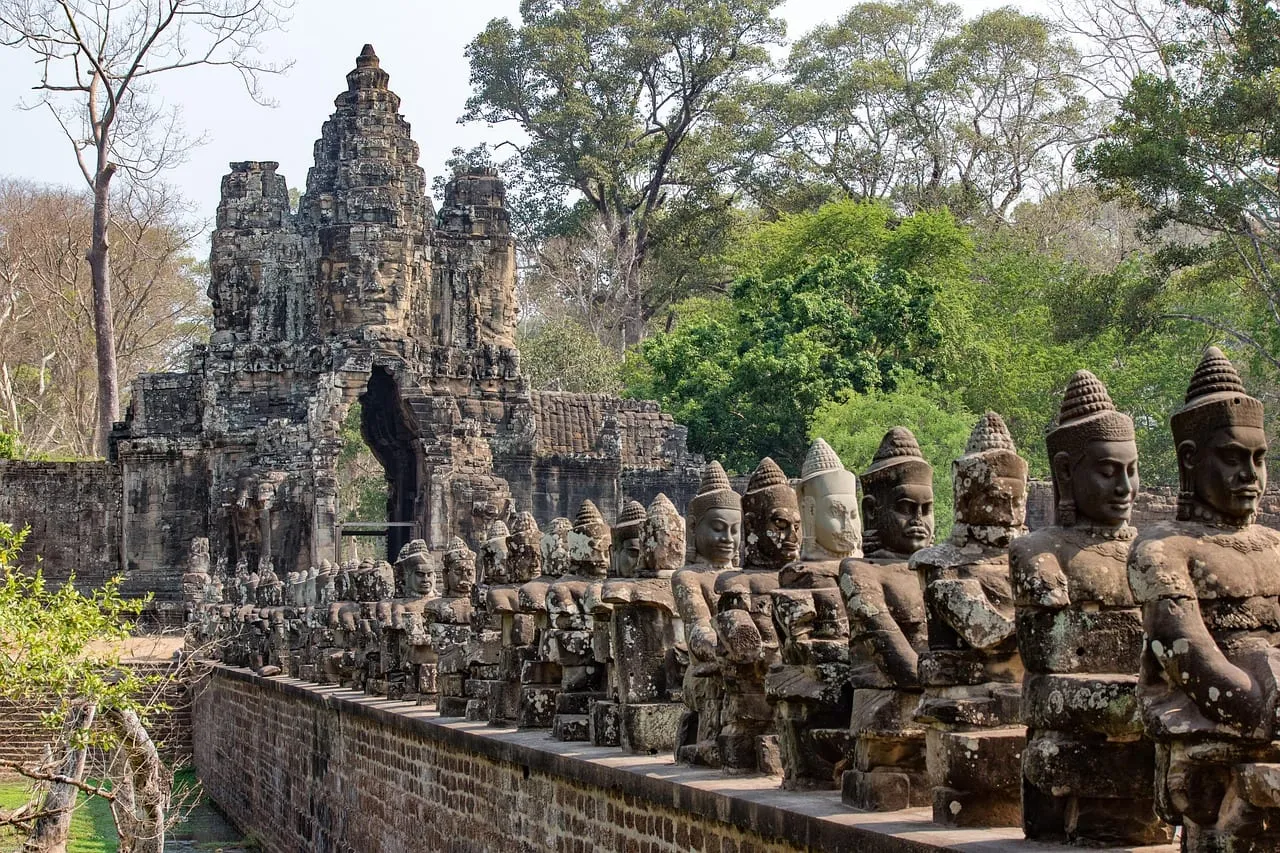
Jayavarman VII's late-12th-century temple at the centre of the walled city of Angkor Thom, with 54 towers carrying 216 calm stone faces. Your pass is checked at the Angkor Thom gates. Pair it with the Terrace of the Elephants and the South Gate's causeway of gods and demons.
Ta Prohm
The temple left half-swallowed by strangler figs and silk-cotton trees, and the one used in the Tomb Raider film. Most people follow the central boardwalk route; the side galleries are much quieter.
Banteay Srei
A small 10th-century temple in pink sandstone with the finest carving at Angkor, about 37 km north of Angkor Wat. It is covered by the Angkor Pass; go early, around 7:30, before the tour buses, and expect drivers to charge extra for the distance.
Sunset from Pre Rup or Phnom Bakheng
Phnom Bakheng is the classic sunset hill but only 300 people are allowed up at once, so the queue fills early. Pre Rup, open until 19:00, gives a long golden hour on red brick with less waiting.
Angkor Wat tickets: which to buy and where
Buy the Angkor Pass from Angkor Enterprise only: online at angkorenterprise.gov.kh or in the Angkor Pass app (QR code by email), or at the ticket office on Road 60. There are no timed slots, so most visitors simply buy online the day before. Tickets are not sold at the temples, and a pass bought anywhere else is not valid.
The official ticket site
Angkor Enterprise (Angkor Pass)
The government ticket seller for the Angkor Archaeological Park. The official site is on the .gov.kh domain (angkorenterprise.gov.kh); it also links its own Angkor Pass app on the App Store and Google Play. Cards accepted online; cash (US dollars or riel) and cards at the Road 60 counter.
1-day Angkor Pass
$37; under 12s free (passport as proof of age)
Official ticketsSkips the ticket line
- Includes
- All temples in the Angkor Archaeological Park on the date printed, entry 5:00–18:30. No photo needed. In practice this covers the small circuit: Angkor Wat, Angkor Thom and the Bayon, Ta Prohm, Phnom Bakheng and the temples around them. Bought after 16:45 for the next day, it also admits you that evening for sunset
- Best for
- A first visit with one day: sunrise, Angkor Wat, the Bayon and Ta Prohm
Angkor Enterprise (official site, app or Road 60 office) · as of October 2026See this ticket → (opens in a new tab)3-day Angkor Pass
$62; under 12s free
Official ticketsSkips the ticket line
- Includes
- Any three days within seven days of the start date (days need not be consecutive). Photo required: taken at the counter or uploaded online. Covers the small and grand circuits and outlying temples such as Banteay Srei
- Best for
- Most visitors who want more than the big three, at a pace that survives the heat
Angkor Enterprise (official site, app or Road 60 office) · as of October 2026See this ticket → (opens in a new tab)7-day Angkor Pass
$72; under 12s free
Official ticketsSkips the ticket line
- Includes
- Any seven days within 30 days of the start date. Photo required. Same access as the 3-day pass
- Best for
- Temple enthusiasts, photographers and anyone staying a week or more
Angkor Enterprise (official site, app or Road 60 office) · as of October 2026See this ticket → (opens in a new tab)Angkor Special Pass (foreign residents)
Free yearly pass, by application
Official ticketsSkips the ticket line
- Includes
- Angkor and Koh Ker, for foreigners holding a Cambodian visa valid for two years or longer. Apply online at spass.angkorenterprise.gov.kh or at the ticket office with passport and photo
- Best for
- Long-term residents of Cambodia only
Angkor Enterprise · as of October 2026See this ticket → (opens in a new tab)
How to buy
- Open angkorenterprise.gov.kh (check the .gov.kh ending) or the Angkor Pass app linked from that site, choose Angkor and the 1-, 3- or 7-day pass, and pick your start date.
- For a 3- or 7-day pass, upload a passport-style photo during checkout. Pay by card (Visa, Mastercard, UnionPay, JCB, Diners or Discover); the QR code arrives by email. Check your spam folder if it does not.
- Save the QR code as a screenshot: mobile data inside the park is patchy, and staff scan it at each temple checkpoint and at the Angkor Thom gates.
- If you prefer to buy in person, the Angkor Ticket Office on Road 60, about 4 km from the centre of Siem Reap, opens at 5:00 (until about 17:30, according to a local guide site) and takes cash (US dollars or riel) and cards. At 5:00 on a sunrise morning there is a queue, which is why buying online the day before is easier.
- Children under 12 need no ticket; carry their passport in case staff ask for proof of age.
Look-alike sites
The only valid seller is Angkor Enterprise, at angkorenterprise.gov.kh (note the .gov.kh government ending), its Angkor Pass app, its self-service kiosks and the ticket office on Road 60. Many tour sites use 'Angkor' in their names and sell 'Angkor Wat tickets'; what they actually sell is a tour, and the pass is either bought for you at the official price or paid separately on the day. Angkor Enterprise states plainly that tickets bought anywhere else are not valid. Prices are fixed at $37, $62 and $72, so any 'discounted' pass is a warning sign.
We can never guarantee a ticket seller, tour company or deal. Prices, opening hours and what is included change, often without notice: check the details on the seller’s own page before you pay, and book through the official site where you can. How to avoid ticket scams · Disclaimer.
Guided tours of Angkor Wat
A licensed guide is worth it on your first day: the temples carry little on-site explanation, and guides know how to route around the tour-group waves. Only licensed guides may lead groups in the park. Shared small-group sunrise tours are cheap; private tours with your own guide, driver and car cost more but set the pace to suit you. On later days a tuk-tuk driver and a good guidebook are enough. The pass is almost never included in tour prices.
Shared small-group guided tour
Angkor Wat: Highlights and Sunrise Guided Tour
 Journey Cambodia (via GetYourGuide)
Hotel pickup in an air-conditioned van, English-speaking guide, water and cold towels. Sunrise at Angkor Wat, two hours inside it, then Ta Prohm, the Victory Gate and the Bayon. Breakfast at Srah Srang at your own cost. Not suitable for under 8s or wheelchair users. Free cancellation up to 24 hours ahead.
from €17 per person, plus the $37 pass
See this tour → (opens in a new tab)Shared small-group guided tour
A-Day Angkor Wat Sunrise Small Group Tour & Key Angkor Temples
 Siem Reap Guide (via Viator)
A local Siem Reap company. Hotel pickup by air-conditioned minivan; sunrise and three hours at Angkor Wat, then the Bayon, Ta Prohm and a photo stop at the South Gate. Meals and tips not included. Viator says it books on average 25 days ahead.
from €18.16 per person, plus the $37 pass
See this tour → (opens in a new tab)Private guided tour with driver
Sunrise Angkor Wat Private Tour
Adventures Cambodia
A Siem Reap operator running private tours only: your own licensed guide, driver and vehicle, breakfast after sunrise and drinks. English, other languages on request. Runs in the rain.
$110 per person; ages 5–11 20% off, under 5 free; pass extra
See this tour → (opens in a new tab)Private guided e-bike tour
Angkor Small Circuit by Electric Bike
Adventures Cambodia
Private e-bike ride round the small circuit with a guide, lunch, water and hotel pickup; bikes are delivered to your hotel. Riders on their own e-bike must be at least 110 cm tall. A good way to cover the forest roads without the heat of a pedal bike.
$95 per person; pass extra
See this tour → (opens in a new tab)
We can never guarantee a ticket seller, tour company or deal. Prices, opening hours and what is included change, often without notice: check the details on the seller’s own page before you pay, and book through the official site where you can. How to avoid ticket scams · Disclaimer.
Angkor Wat deals and discounts
The official Angkor Pass is the only ticket and its price is fixed; nobody can sell it cheaper. The real savings are the free entry for under 12s, the free sunset the evening before a 1-day pass starts, and the 3-day pass, which costs less than two single days.
Free for children under 12
Under 12s need no ticket at all. Carry their passport, since staff may ask for proof of age. They may not climb the Bakan, Angkor Wat's upper tier.
Free sunset the evening before
Buy a pass dated for tomorrow and you can enter after 16:45 today for sunset, without using a day of the pass.
3-day pass for less than two single days
$62 for any three days within a week, against $74 for two 1-day passes. The days need not be consecutive, so you can rest in the heat between temple days. The 7-day pass ($72) runs over 30 days.
Free entry for Cambodians
Cambodian citizens enter free, as do Cambodian guides and drivers. Foreigners with a Cambodian visa valid for two years or more can apply for the free Special Pass. The official site lists no senior or student discounts.
Best time to visit Angkor Wat
Time of day: arrive at Angkor Wat by 5:00 for sunrise (first light around 5:30–5:45), stay inside once the sunrise crowd leaves for breakfast, then do the Bayon and Ta Prohm before the late-morning heat. The tour-group rush at the main temples runs roughly from 8:00 to 10:00. Local operators give the upper level's opening as around 7:40 (one guide site says 6:40); there is no official timetable, and it is busiest in its first hour.
Season: November to February is dry and coolest (25–30°C) but busiest, especially around Christmas and New Year. March to May is very hot, reaching about 40°C. June to October is the rainy season: the temples are quietest and mornings are often dry, with rain coming in the afternoon, but outlying roads can turn muddy.
What to watch for: local operators say the Bakan (upper level) closes on Buddhist holy days, which follow the lunar calendar. Angkor Enterprise publishes no list of these days, so if climbing to the top matters to you, ask your guide or hotel about your dates. A cloudy morning makes for a flat sunrise; locals suggest deciding on the day rather than locking in a sunrise trip far ahead.
Tips and tricks
Gathered from travel forums, locals and the sight’s own advice, rewritten in our own words. What worked for others, not a guarantee.
Buy the pass the evening before
Buy a pass online for the next day and enter after 16:45 for a free sunset. Next morning you go straight to the temple at 5:00 without the ticket-office queue.
From Angkor Enterprise FAQ, 2026
Stand at the north pool for sunrise
Inside the west entrance, take the left-hand (north) reflecting pool. It is usually less crowded than the south pool, and the far left gives the best angle in the dry season, when the sun comes up to the right of the towers.
From Wikivoyage Angkor Archaeological Park, 2026; local operator guide, 2026
Dress for the Bakan, not just the heat
Wear a top that covers your shoulders and trousers or a skirt below the knee. At the upper tier a scarf over bare shoulders is refused, and visitors who climb up in a vest top are turned back. Vendors near the temple sell T-shirts if you get caught out.
From Angkor Visitor Code of Conduct; Wikivoyage, 2026
Hire the driver and the guide separately, or as a package
Tuk-tuk drivers drive; they do not guide. Posts on the TripAdvisor Siem Reap forum in March 2026 put a tuk-tuk at about $15 for a full day and a car with driver and licensed guide at about $50; hotels add a mark-up. A half day is rarely half price.
From TripAdvisor Siem Reap forum, March 2026
Expect a small surcharge for sunrise and far temples
Drivers usually charge a few dollars more for a pre-dawn start (about $5 in older forum reports) and more for Banteay Srei or Beng Mealea. One tuk-tuk takes up to four people at the same price, so agree the full route and total before you set off.
From TripAdvisor Siem Reap forum (2018 thread); Wikivoyage, 2026
Go to Ta Prohm's side galleries
Most visitors follow the central route through Ta Prohm for the famous tree roots. The side galleries are often almost empty, even at busy times.
From Wikivoyage Angkor Archaeological Park, 2026
Pick Pre Rup over Phnom Bakheng for sunset
Phnom Bakheng allows 300 people at a time and the queue fills well before sunset. Pre Rup stays open until 19:00 and you can walk straight up.
From Local operator opening-hours guide, 2026
Rent a bicycle or e-bike for the small circuit
Angkor Wat is about 6 km from town and the small-circuit temples are 15 minutes apart by bike on shaded, low-traffic roads. Wikivoyage lists bicycles at about $3–4 a day and electric scooters from about $6 (2026). Rent the day before if you want a sunrise start, because shops open at about 7:00.
From Wikivoyage Angkor Archaeological Park, 2026
Carry water and small dollar notes
Drinks are sold outside every major temple, but at higher prices than in town. US dollars are used everywhere, with riel as change.
From Wikivoyage Angkor Archaeological Park, 2026

How to get to Angkor Wat
- From Siem Reap: Angkor Wat is about 6 km north of the town centre. Most people go by tuk-tuk hired for the day (about $15–20 for the small circuit, going by 2026 forum reports), by car with driver, or by bicycle or e-bike. If you need to buy the pass in person, stop first at the Angkor Ticket Office on Road 60, about 4 km from the centre; it is not on the direct road to the temples.
- From the airport: Siem Reap Angkor International Airport (SAI), opened in October 2023, is about 50 km east of Siem Reap and 40 km from Angkor Wat, so allow 50–60 minutes by car; transfers can be booked ahead.
- Overland: land crossings between Thailand and Cambodia are suspended (UK FCDO advice updated 19 March 2026, still current at 6 October 2026), so the old Bangkok–Poipet–Siem Reap bus route is not an option. Fly in, or come by road from Phnom Penh.
- Inside the park: Angkor Wat is entered over the restored western causeway, and the floating pontoon bridge just to its south is the exit. Agree a meeting point with your driver before you go in.
Scams and problems to watch for
Second-hand or 'cheap' passes
Passes are sold only by Angkor Enterprise at fixed prices, 3- and 7-day passes carry your photo, and QR codes are scanned at each temple. A pass offered by a stranger, a guesthouse at a discount, or a site that is not angkorenterprise.gov.kh will not get you in.
Unofficial guides at the temples
Men in uniform, sometimes off-duty police, start walking beside you and explaining the temple, then ask for $10 or more at the end. Say at the start that you are fine on your own, or agree a price first. Licensed guides are booked in advance and carry an official badge.
Incense and fake monks
Someone hands you incense, 'teaches' a blessing and then asks for a donation of around $10 'for the monks'. Theravada monks do not solicit money. A polite 'no thank you' before you take the incense ends it.
Children selling and begging
Children sell postcards and bracelets at most temples. The park's own code of conduct asks visitors not to buy from children or give them money or sweets, because it keeps them out of school; give to a recognised charity instead. On bike rides, some children ask for high fives and try to take rings off fingers.
Bag snatching from motorbikes
The UK FCDO says most theft in Siem Reap is bag and phone snatching by thieves on passing motorbikes, including from tuk-tuk passengers. Keep bags on the side away from the road, never in a bicycle's front basket, and choose tuk-tuks with side grilles.
Unlicensed drivers after dark
Licensed tuk-tuk and moto drivers wear a grey numbered vest inside the park. The FCDO reports assaults on lone women by men posing as moto-taxi drivers around Pub Street; book transport through your hotel at night.
Accessibility
Angkor is hard going with limited mobility. Temple floors are uneven stone, there are high thresholds and steep steps almost everywhere, and the stairway to Angkor Wat's upper tier (Bakan) is a near-vertical wooden staircase, closed to under 12s. The approach over the restored western causeway is long but level, and the floating pontoon bridge to the south serves as the exit. We found no official information on wheelchair loan, step-free routes or reduced tickets for disabled visitors, and there are no disability discounts on the pass. A private car with a driver who can drop you at each temple entrance and wait at the exit makes the biggest difference; several tour operators state their tours are not suitable for wheelchair users.
Combine it with
Angkor Thom and the Bayon
The walled royal city just north of Angkor Wat, with the face towers of the Bayon, the Baphuon and the Terrace of the Elephants. Covered by the same pass and part of every one-day route.
Ta Prohm
The jungle temple held together by tree roots, just east of Angkor Thom on the small circuit. Best seen early or late morning before the groups arrive.
Banteay Srei
The pink-sandstone temple with Angkor's finest carving, 37 km north. Covered by the pass; combine it with the waterfall riverbed at Kbal Spean, 8 km further on.
Siem Reap town
The base for every visit: the riverside, the old market and Pub Street, a short tuk-tuk ride from the temples. The Phare circus is a popular evening show.
Tonlé Sap floating villages
Stilt and floating villages such as Kampong Phluk and Chong Kneas on the Tonlé Sap lake; Chong Kneas is about 11 km south of town. Chong Kneas boat tickets are sold only at Angkor Enterprise's counter there; half-day tours to Kampong Phluk start from about €22 on Viator.
Questions people ask about visiting Angkor Wat
Where do I buy Angkor Wat tickets?
Only from Angkor Enterprise: online at angkorenterprise.gov.kh, in the official Angkor Pass app, at its self-service kiosks or at the ticket office on Road 60 in Siem Reap. Tickets are not sold at the temples, and a pass bought anywhere else is not valid (October 2026).
How much is the Angkor Pass?
$37 for one day, $62 for any three days within a week, and $72 for any seven days within a month. Children under 12 are free. These prices were confirmed on the official site in October 2026, which lists no senior or student discounts.
Do I need to book Angkor Wat tickets in advance?
There are no timed slots and passes do not sell out, so you can buy on the day. Buying online the day before is still the smart move: you skip the 5:00 queue at the ticket office on sunrise mornings, and a pass dated for tomorrow lets you in after 16:45 today for a free sunset.
What time does Angkor Wat open for sunrise?
Angkor Wat opens at 5:00 and closes at 18:00; most other temples run 6:00–18:30. First light is around 5:30–5:45, so plan to be at the west entrance by 5:00. The ticket office also opens at 5:00, which is why it pays to buy the evening before or online (October 2026).
What is the dress code at Angkor Wat?
Cover your shoulders and knees: no shorts or skirts above the knee and no bare shoulders in sacred areas. The rule is strictly enforced at the upper level (Bakan), where a scarf over bare shoulders is not accepted. Under 12s may not climb the Bakan, and local operators say it also closes on Buddhist holy days.
Is a 1-day pass enough for Angkor?
One day covers the small circuit: sunrise at Angkor Wat, the Bayon, Ta Prohm and a few smaller temples. Most visitors who can spare the time take the 3-day pass ($62) to add the grand circuit and Banteay Srei and to avoid touring through the midday heat.
Is it safe to visit Angkor Wat with the Thailand–Cambodia border tensions?
The UK FCDO advises against all but essential travel within 20 km of the Thai border, after fighting along the border in 2025 and a ceasefire signed on 27 December 2025; land crossings remain suspended (advice updated 19 March 2026, still current at 6 October 2026). Siem Reap and the Angkor park lie well over 20 km from the border, outside that zone. Arrive by air and check the latest advice before you go.
Before you go
The things that apply at every big sight: booking ahead, what skip-the-line really means, and the scams that follow tourists everywhere.