Amber Fort
Jaipur, India
आमेर किला (Amer Fort)
The Kachhwaha kings' hilltop palace above Maota Lake, with its famous hall of mirrors.
Checked 7 October 2026
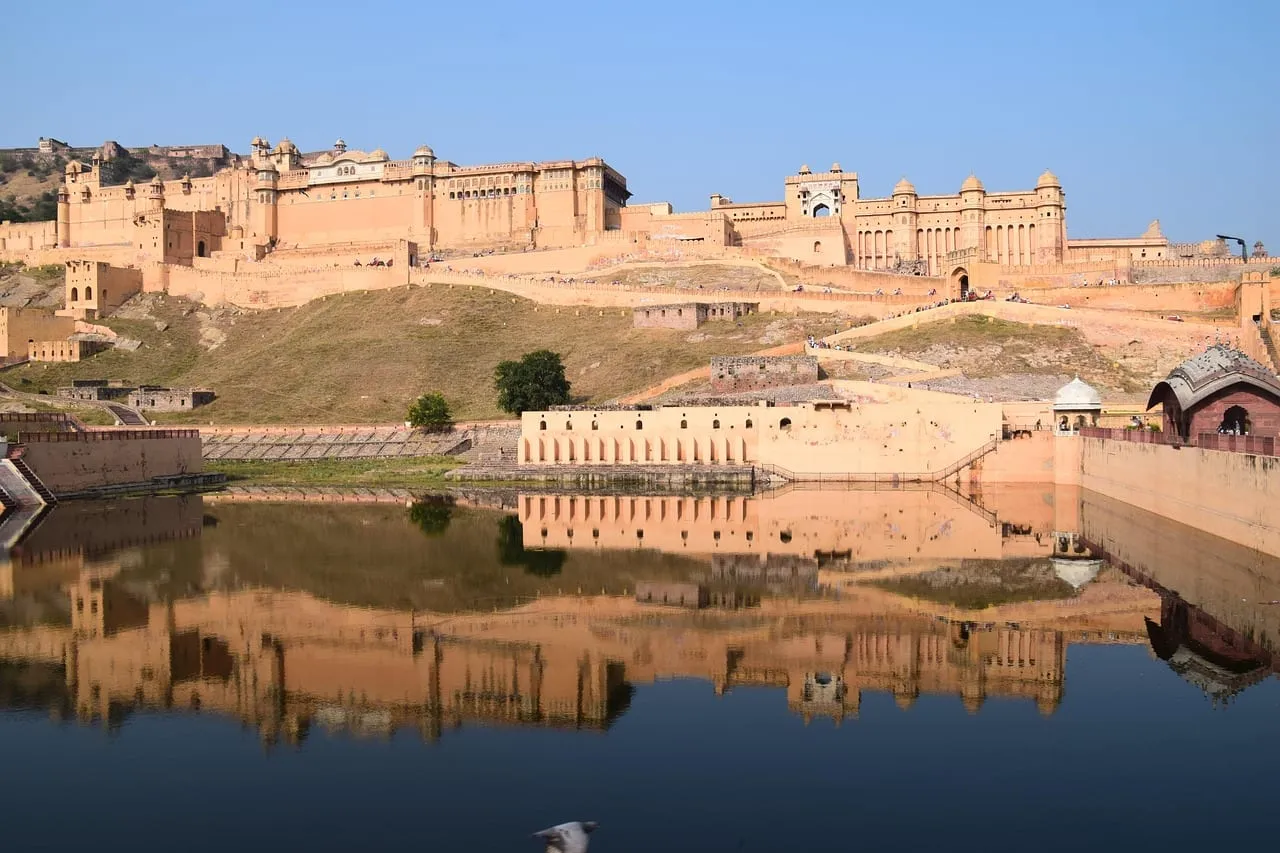
Amber (Amer) Fort is the hilltop palace the Kachhwaha Rajput rulers built from 1592, before they moved their capital down to Jaipur; it is run by Rajasthan's Department of Archaeology and Museums. Prices doubled in January 2026: foreigners now pay ₹1,000, so if you will also see Hawa Mahal and Jantar Mantar, the ₹1,700 two-day Jaipur composite ticket from the state's own OBMS portal is the better buy.
About Amber Fort
Amber Fort is not really a fort but a palace complex: four courtyards of pale yellow sandstone and white marble climbing a ridge of the Aravalli hills, looking down on Maota Lake and the old town of Amer. The real fort is Jaigarh, on the hill directly above, and the two are linked by walls and a passage, so they were run as one defensive system.
Amer was the capital of the Kachhwaha Rajputs for centuries before Sawai Jai Singh II founded Jaipur on the plain in 1727. Raja Man Singh I, a general of the Mughal emperor Akbar, began the present palace in the late 16th century, and Mirza Raja Jai Singh I and Sawai Jai Singh II rebuilt and redecorated it. That close link to the Mughal court is why Hindu temple motifs sit next to Mughal gardens, arches and inlay.
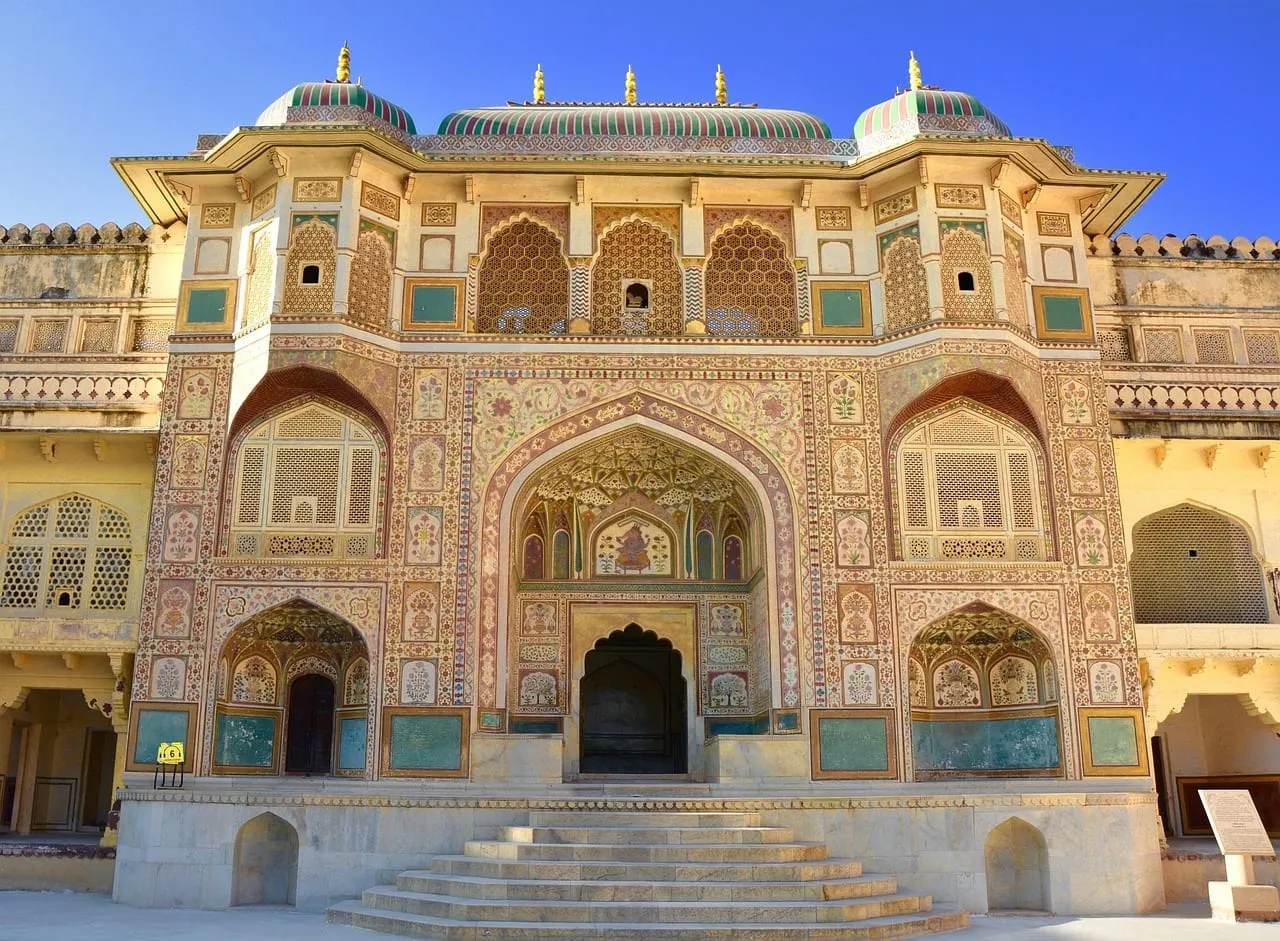
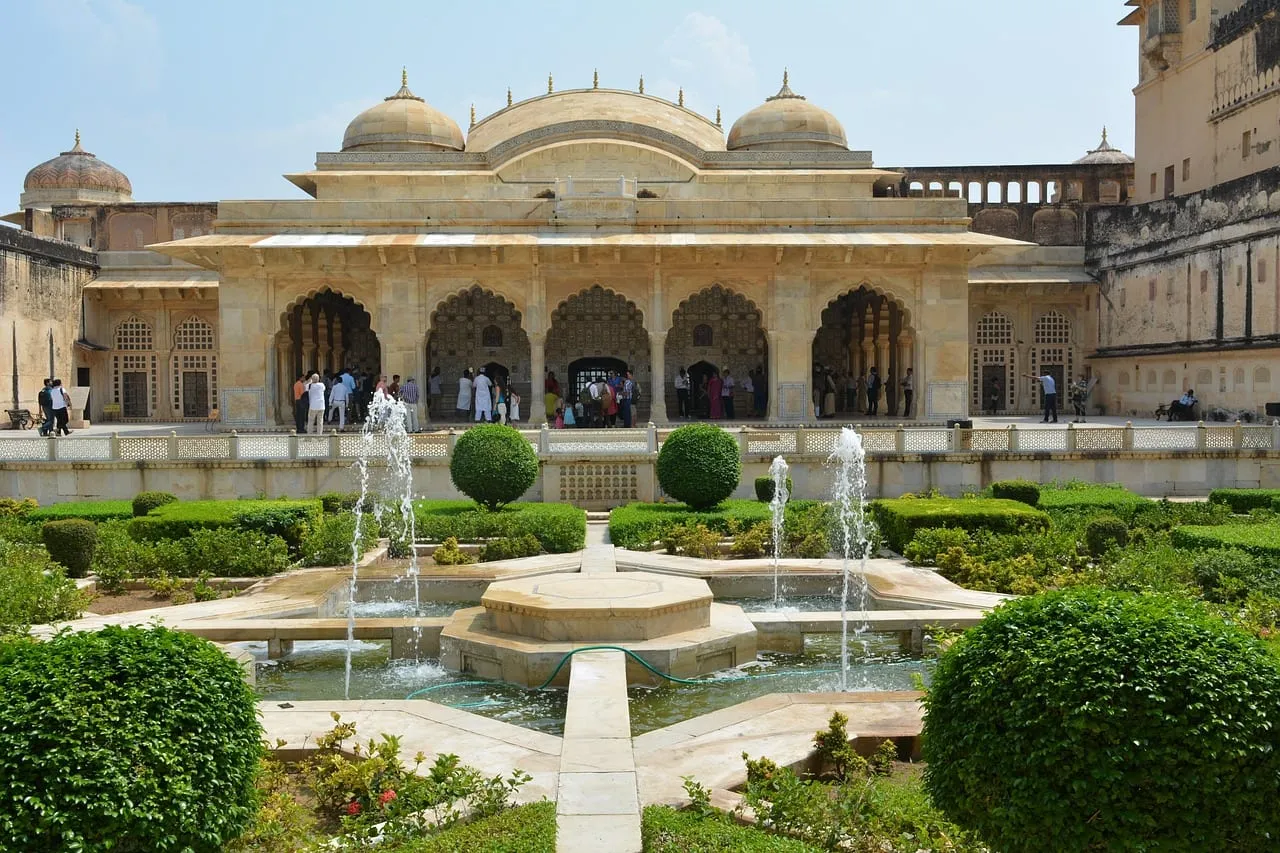
The order of a visit follows the order of rank. You enter through Suraj Pol into Jaleb Chowk, the parade ground for the royal guard, climb to the Diwan-i-Aam where the ruler heard petitions, then pass through the painted Ganesh Pol into the private palace: the mirror-covered Jai Mandir (Sheesh Mahal) facing the water-cooled Sukh Niwas across a Mughal garden. Behind lie the zenana quarters of the royal women and the oldest part, Man Singh I's palace, completed in 1599.
In 2013 UNESCO listed Amber with five other Rajasthan hill forts as one World Heritage site, as examples of Rajput military hill architecture. It is the most visited sight in Jaipur, which shapes the practical side of a visit: midday crowds, touts at the bottom of the hill, a long-running debate over the elephant rides, and a state ticket system that rewards buying one composite ticket for the whole city.
What to see
Sheesh Mahal (Jai Mandir)
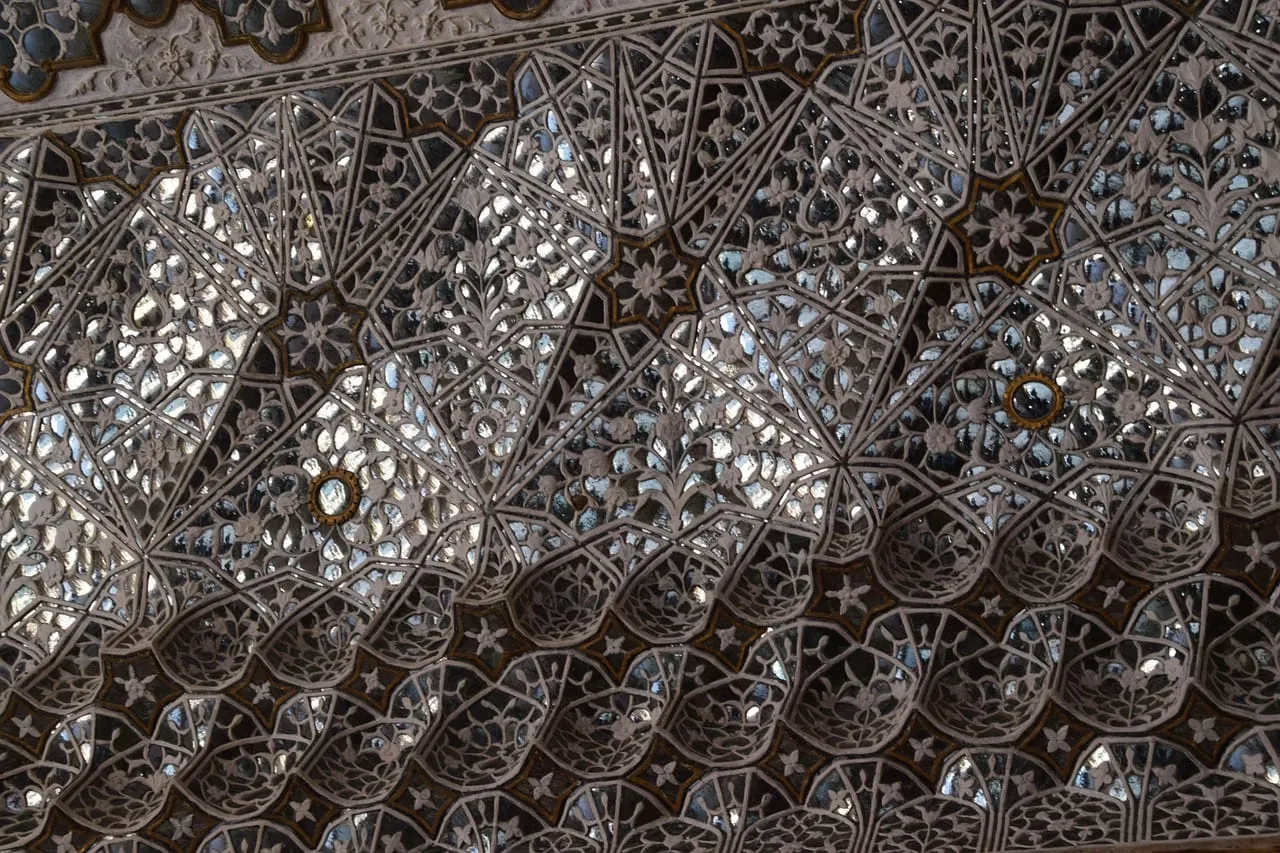
The hall of mirrors: walls and ceilings set with thousands of small convex mirror pieces and coloured foil in plaster, which glitter in candle or torch light. Go early, before the groups bunch up in the doorway. On top sits Jas Mandir, the private audience hall, with alabaster relief and floral glass inlay.
Ganesh Pol
The three-storey painted gateway into the private palace, built for Mirza Raja Jai Singh I in the 17th century. Above it is Suhag Mandir, where the royal women watched events in the Diwan-i-Aam through stone screens. It is the most photographed spot inside; the light is softest in the morning.
Sukh Niwas and the Mughal garden
Facing the Sheesh Mahal across a sunken star-shaped garden, Sukh Niwas was cooled by water running in an open marble channel through the hall and out into the garden, an early form of air conditioning. Look for the sandalwood door and the marble niches.
Diwan-i-Aam
The hall of public audience, a raised platform with double rows of columns topped by elephant-shaped capitals. From its edge you get the best view down over Jaleb Chowk, the ramp and Maota Lake.
Man Singh I's palace and the zenana
The oldest part of the complex, finished in 1599, with a pillared baradari pavilion in the middle of the courtyard. Around it, the queens' rooms open onto a shared corridor, so the ruler could visit any of them unseen. Quieter than the front courtyards, even at midday.
Shila Devi temple
The royal family's temple to the right of the stairs from Jaleb Chowk, with silver-covered double doors and silver lions flanking the goddess, whose image Man Singh I is said to have brought from Bengal. It is an active temple: take your shoes off and follow the rules posted at the door.
Kesar Kyari and Maota Lake
The geometric saffron garden laid out in the lake below the palace is best seen from the ramparts and from the road along the lake on the way up. In the evening the light and sound show is staged facing the illuminated fort, with Jaigarh on the hill to the left.
Amber Fort tickets: which to buy and where
Foreign visitors should normally buy the Jaipur composite ticket (₹1,700) instead of the ₹1,000 Amber-only ticket: it pays for itself as soon as you add Hawa Mahal and Jantar Mantar. The official portal gives it two days' validity, although a December 2025 news report said this would be extended to 10 days, so check the validity shown when you book. Buy it on the official OBMS portal or at the counter; it does not cover City Palace or Jaigarh Fort, which sell their own tickets.
The official ticket site
Rajasthan Department of Archaeology and Museums, via the state's Online Booking Management System (OBMS)
The official online seller is the Government of Rajasthan's OBMS portal on obms-tourist.rajasthan.gov.in (run by RISL, the state IT company). It sells Amber, the Jaipur and Rajasthan composite tickets and other state monuments. You need to log in (a Rajasthan SSO ID or the portal's own sign-up) and you get a QR 'boarding pass' to show at the gate. The ticket counters at the fort sell the same tickets at the same prices.
Amber Fort general ticket, foreign visitor
₹1,000 adult; ₹500 foreign student with a valid student ID; under 7 free
(€9 · €5)
Official ticketsSkips some lines
- Includes
- Amber palace complex, all courtyards; one entry on the chosen day. Does not include Jaigarh Fort, the light and sound show or the elephant ride
- Best for
- Visitors who only have time for Amber. A QR ticket bought online skips the counter queue, not the security check
OBMS (official) · as of October 2026See this ticket → (opens in a new tab)Jaipur composite ticket (Jaipur Darshan), foreign visitor
₹1,700 adult; ₹800 foreign student
(€16 · €8)
Official ticketsSkips some lines
- Includes
- Amber Fort, Hawa Mahal, Jantar Mantar, Nahargarh Fort, Albert Hall Museum, Isarlat, Sisodia Rani Bagh, Vidyadhar Garden, Gandhi Vatika Museum and Jaipur Metro Kala Deergha; valid two days from the visit date you pick, per the portal (a December 2025 news report said validity would rise to 10 days; check what the portal shows when you book). Not City Palace or Jaigarh
- Best for
- Anyone seeing Amber plus at least two more state monuments in Jaipur (Hawa Mahal and Jantar Mantar alone are ₹600 each for foreigners)
OBMS (official) · as of October 2026See this ticket → (opens in a new tab)Amber Fort general ticket, Indian citizen
₹200 adult; ₹100 student with ID; under 7 free
(€2 · under €1)
Official ticketsSkips some lines
- Includes
- Amber palace complex; Indian composite ticket ₹550 (₹180 students) for the same ten Jaipur sites
- Best for
- Indian nationals; carry photo ID
OBMS (official) · as of October 2026See this ticket → (opens in a new tab)Rajasthan composite ticket (Rajasthan Darshan)
₹5,500 foreign adult; ₹2,800 foreign student; ₹1,300 Indian; ₹600 Indian student
(€52 · €26 · €12 · €6)
Official ticketsSkips some lines
- Includes
- Monuments and museums of the state Department of Archaeology and Museums across Rajasthan, valid 10 days. Not the private palaces (City Palace Jaipur and Udaipur, Mehrangarh) or ASI sites
- Best for
- Long Rajasthan trips covering many state-run monuments; check the list against your route before buying
OBMS (official) · as of October 2026See this ticket → (opens in a new tab)Half-day private tour with Amber Fort
from €23 per person, entry tickets extra (paid in cash to the guide)
ResellerSkips the ticket line
- Includes
- Private car and licensed English-speaking guide for 4 hours: Hawa Mahal photo stop, Panna Meena ka Kund, Amber Fort, Jal Mahal; the guide buys the composite ticket for you
- Best for
- First-timers who want transport and a guide in one; you still pay the official ticket price on top
 GetYourGuide (Hii-Stories) · as of October 2026See this ticket → (opens in a new tab)
How to buy
- Decide first: Amber only (₹1,000 foreigners) or the Jaipur composite (₹1,700, two days on the portal in October 2026). If Hawa Mahal or Jantar Mantar are on your list, take the composite.
- Online: open obms-tourist.rajasthan.gov.in, choose Amber Fort or Composite > Jaipur Darshan, log in or register, pick the visit date and pay. Save the QR boarding pass on your phone.
- Or buy at the counter at the fort; the prices are the same. Students need a valid student ID card for the reduced price, at the counter and at the gate.
- At the gate, show the QR code (or paper ticket) and go through the bag check. The composite ticket is scanned once at each site, so keep it until you have seen them all.
Look-alike sites
The only official online seller is the Rajasthan government's OBMS portal on obms-tourist.rajasthan.gov.in, run for the Department of Archaeology and Museums; the old Rajasthan Tourism pages on tourism.rajasthan.gov.in give information but do not sell Amber tickets. Search results also show private 'Amber Fort ticket' sites and tour sellers whose 'tickets' are really a guide or car package with the entry fee added. Check that the address ends in rajasthan.gov.in and that the price matches the official one (₹1,000 or ₹1,700 composite for foreigners in 2026). Anything higher is a package, not a ticket.
We can never guarantee a ticket seller, tour company or deal. Prices, opening hours and what is included change, often without notice: check the details on the seller’s own page before you pay, and book through the official site where you can. How to avoid ticket scams · Disclaimer.
Guided tours of Amber Fort
Inside, the palace has few signs, so a guide makes the courtyards, the zenana and the history much easier to follow; a licensed guide at the entrance costs little. Car-and-guide half-day tours are mainly worth it for the transport between Amber, Panna Meena ka Kund, Jal Mahal and the city. If you just want to wander and photograph, go alone at opening time.
Private guided visit on the spot
Licensed guide at the entrance
 Government-licensed guides at the fort
Hire at the ticket area inside, not on the road below. Approved guides carry a government licence card: ask to see it and agree the price and length before starting. Entry tickets are extra. No official guide rate is published, so treat the figure as a guide only.
about ₹400 for 1–4 people (reported January 2026; agree before you start)
(€4)
See this tour → (opens in a new tab)Private walking tour
Amber Fort Guided Walking Tour
Crystal India HolidaysEnglish or Hindi; covers Diwan-i-Aam, Sheesh Mahal, zenana and ramparts. Entry tickets are not listed as included, so budget the official price on top.
€13 per group up to 10
See this tour → (opens in a new tab)Private car and guide, half or full day
Jaipur & Amber Fort Full- or Half-Day Guided Tour
Hello India ToursPick-up in Jaipur, start between 7:00 and 15:00, many guide languages. The itinerary lists shopping stops at Amber Fort and Jal Mahal, and GetYourGuide's review summary mentions sales pressure; say at the start if you do not want shop visits.
from €7 per person (sale price; €14 normally); tickets and lunch only in the upgraded option
See this tour → (opens in a new tab)Private evening tour with transport
Evening Tour with Amber Fort Light & Sound Show
India Rajasthan Tour CabLate afternoon to night: Hawa Mahal and Jal Mahal from outside, Isarlat tower, then the light and sound show at Amber (ticket included if you choose that option). Useful mainly for the late return from Amber, when buses are fewer. Shows can be cancelled around festivals; one reviewer's tour fell through at Holi in March 2026.
from €24 per person
See this tour → (opens in a new tab)
We can never guarantee a ticket seller, tour company or deal. Prices, opening hours and what is included change, often without notice: check the details on the seller’s own page before you pay, and book through the official site where you can. How to avoid ticket scams · Disclaimer.
Amber Fort deals and discounts
The real saving is the Jaipur composite ticket: for foreigners ₹1,700 against ₹2,200 for Amber, Hawa Mahal and Jantar Mantar bought separately, and you can add Nahargarh and Albert Hall for nothing. Students with ID pay half, and entry is free for everyone on four days a year.
Jaipur composite ticket
₹1,700 for foreigners (₹800 students), ₹550 for Indians (₹180 students), covering Amber, Hawa Mahal, Jantar Mantar, Nahargarh, Albert Hall and five smaller sites. The portal says it is valid two days from the date you choose; a December 2025 news report said this would become 10 days, so check the validity shown when you book. For foreigners it pays off from the third monument.
Student prices
Foreign students pay ₹500 for Amber and ₹800 for the composite; Indian students ₹100 and ₹180. You must show a valid student ID card. School and college groups with a letter from their institute get in free between 10:00 and 17:00.
Free for children under 7
Children below 7 years enter free; there is no separate child rate above that age, so older children pay the adult or student price.
Four free-entry days
Entry is free for everyone on Rajasthan Day (Rajasthan Diwas; the portal used to give 30 March, now just 'Rajasthan Diwas', so check the date), World Heritage Day (18 April), International Museum Day (18 May) and World Tourism Day (27 September). Expect very large crowds on those days.
Rajasthan composite ticket for long trips
₹5,500 for foreigners for 10 days of state-run monuments and museums across Rajasthan. It only pays off on a long route through many Department of Archaeology sites; the big private palaces and the ASI sites are not on it.
Best time to visit Amber Fort
Time of day: be at the gate at opening (7:00 on the official portal). Coach groups and day-trippers from Jaipur arrive from about 9:30, and by late morning the Sheesh Mahal doorway and Ganesh Pol are crowded. The courtyards are open stone and very hot between 11:00 and 15:00 for much of the year.
Season: October to March is the main season, with mild days (cold early mornings in December and January). April to June is very hot; July to September is the monsoon, with greener hills, fewer tourists and wet, slippery stone ramps.
Avoid: Indian holiday weekends, the four free-entry days and Diwali week, when domestic crowds peak. The fort is closed on Dhulandi, the colour day of Holi in March, and evening programmes can be cancelled around festivals.
Tips and tricks
Gathered from travel forums, locals and the sight’s own advice, rewritten in our own words. What worked for others, not a guarantee.
Walk up from Maota Lake
The cobbled ramp from the road by Maota Lake up to Suraj Pol takes about 15 minutes at an easy pace and gives the classic view of the walls above the lake. Go up early, before the sun is on the ramp.
From Thrilling Travel Amer Fort guide, March 2026
Go to the Sheesh Mahal first
Crowds build from about 9:30, when the first groups arrive and walk the courtyards in order. If you are in at opening, head straight through Ganesh Pol to the Sheesh Mahal and do the Diwan-i-Aam and Jaleb Chowk on the way out.
From Thrilling Travel Amer Fort guide, March 2026
Elephant rides: mornings only
Elephant rides up the ramp run only in the morning, and the elephants have a daily quota that is often used up by about 11:00 in season. In January 2025 the state fixed the price at ₹1,500 per ride, with a 5% rise each year, so expect a little more now. In December 2025 PETA India reported another incident with ride elephants at Amer, listed earlier ones and inspection findings, and repeated its call to end the rides; many international tour companies no longer sell them. The other ways up are the walk from Maota Lake or a jeep up the back road.
From Rajasthan Tourism; IANS report, January 2025; PETA India, December 2025
Use the jeeps on the back road
Jeeps run up the back road to the Chand Pol side of Jaleb Chowk. A return trip was reported at ₹500–800 per jeep in March 2026: agree the price, the number of people and whether the driver waits before you get in.
From Thrilling Travel Amer Fort guide, March 2026
Buy the composite before your first Jaipur sight
The portal gives the composite two days from the date you pick, so if you start with Hawa Mahal or Jantar Mantar on the afternoon before, buy the composite there and use day two for Amber and Nahargarh.
From Official OBMS Jaipur Darshan page, 2026
Add Panna Meena ka Kund on foot
The symmetrical stepwell is a short walk below the fort in Amer village and free to see from its rim. Combine it with Anokhi Museum of Hand Printing nearby for a quieter hour after the palace.
From GetYourGuide tour itineraries, 2026
Bring water and a hat
The courtyards and ramparts are open stone with little shade, and the climb up adds to it. Carry water, and take your shoes off only for the Shila Devi temple.
From Wikipedia, Amber Fort; GetYourGuide tour notes, 2026
Catch the light and sound show
The show below the fort tells Amber's history in English and in Hindi each evening, with tickets sold at the venue, not on the OBMS portal. Government pages disagree on the times: Rajasthan Tourism gives seasonal times (English at 18:30 in October–February, later in summer), Incredible India gives 19:30 English and 20:00 Hindi. Check the time and price at the venue or with your hotel on the day.
From Rajasthan Tourism Jaipur page; Incredible India Amber Fort page, 2026
Stay for the evening if you have a cab
The official portal lists closing at 20:00, and the walls are lit after dark, when the day crowds have gone. Buses back to the city are less frequent in the evening, so arrange a cab or an evening tour.
From Official OBMS timings and Rajasthan Tourism, 2026
How to get to Amber Fort
- From Jaipur centre by bus: the city bus company JCTSL runs line AC-1 from Ajmeri Gate (by the old city walls) to the Amber Fort stop below the palace about every 15 minutes; it takes around 40 minutes and costs a few tens of rupees.
- By cab: Amber is 11 km north of the centre, 20 minutes without traffic and 40 or more at peak times. Uber and Ola work in Jaipur; a one-way ride was reported at about ₹300 in March 2026. App cabs drop you on the road by Maota Lake, from where you walk up or take a jeep.
- By auto-rickshaw: agree the price before you set off, and whether the driver waits and takes you back. Refuse any detour to a gem, textile or 'government' shop on the way.
- To Jaigarh Fort: a steep path climbs from Amber up to Jaigarh on the hill above; the two forts are linked by walls and an old escape passage, part of which visitors can walk. Jaigarh is privately managed and sells its own ticket; the composite does not cover it. By road it is a separate drive up the hill.
- From the airport or Jaipur Junction station: take an app cab straight to Amber, or go to Ajmeri Gate and take the AC-1 bus.
Scams and problems to watch for
The gem shop detour
A rickshaw or taxi driver offers a cheap ride to Amber, then stops at a gem, jewellery or textile 'factory' on the way, where you are offered stones you can supposedly resell at home for a big profit. The stones are glass or low-grade, and there is no resale. Tell-tale sign: anyone mentioning gems for export or resale. Say no and leave.
Unlicensed guides on the road below
Men on the road by Maota Lake and on the ramp offer to guide you 'for a cheap price', then take you through quickly and ask for much more at the end. Approved guides work from the ticket area and carry a government licence card; ask to see it and agree the price first.
'Fort closed today' and 'ticket office moved'
Someone tells you the fort is closed, the ticket office is somewhere else or you need to buy tickets from them. Amber is open every day except Dhulandi, the colour day of Holi; buy only at the official counter or on obms-tourist.rajasthan.gov.in.
Overpriced 'tickets' and packages
Agents and some websites sell 'Amber Fort tickets' for far more than the official ₹1,000 (₹1,700 composite), sometimes as a package with a guide. Tell-tale sign: the price is not the official one and the seller is not on rajasthan.gov.in.
Photo touts and hawkers
Costumed snake charmers, turbaned men and children pose for photos, then ask for money, and hawkers follow you up the ramp with trinkets. If you take a picture, agree the tip first; otherwise keep walking.
The jeep and elephant price switch
A jeep or elephant price is quoted per vehicle at the bottom and turns into 'per person' or 'one way only' at the top. Agree the total, the number of people and whether it includes the return before you go.
Accessibility
Amber is a hillside palace with steep cobbled ramps, many steps between courtyards and uneven stone floors, so it is hard for wheelchair users and tiring for anyone with limited mobility. Vehicles and jeeps can drive up the back road to the Chand Pol side of Jaleb Chowk, which avoids the ramp from Maota Lake, but the climb from Jaleb Chowk to the Diwan-i-Aam and the private palace is by stairs. No official information on wheelchair loans or step-free routes is published, and several tour operators list their Amber tours as not suitable for wheelchair users. There is no disabled-visitor discount in the official price list; children under 7 enter free.
Combine it with
Jaigarh Fort
The real military fort on the hill above Amber, with the huge Jaivana cannon and views over Amber and Maota Lake. Walk up the path from the back of the palace; separate ticket.
Panna Meena ka Kund
A 16th-century stepwell with criss-cross staircases a few minutes' walk below the fort in Amer village. Free to view from the edge; go before the tour groups.
Jal Mahal
The palace in Man Sagar Lake on the road back to Jaipur, seen from the lakeside promenade (you cannot go inside). A natural photo stop on the way between Amber and the city.
Nahargarh Fort
The ridge-top fort above Jaipur, on the composite ticket and open until 22:00, with the best sunset view over the city. Reached by road from the Amber side.
Taj Mahal
On SightsaleThe next stop for most visitors on the Golden Triangle (Delhi, Agra, Jaipur): Agra is about four to five hours east by road or train, so plan it as a separate day.
Questions people ask about visiting Amber Fort
How much is the Amber Fort ticket for foreigners?
Since 1 January 2026 the ticket is ₹1,000 for foreign adults and ₹500 for foreign students with ID; Indians pay ₹200. Children under 7 are free. The Jaipur composite ticket, which includes Amber, Hawa Mahal, Jantar Mantar, Nahargarh and Albert Hall, costs ₹1,700 for foreigners (October 2026).
Where can I buy Amber Fort tickets online?
On the Rajasthan government's OBMS portal, obms-tourist.rajasthan.gov.in, which sells tickets for the state Department of Archaeology and Museums. You get a QR code to show at the gate. The counters at the fort sell the same tickets at the same price, so booking ahead is not required.
Is the Jaipur composite ticket worth it?
For foreigners, yes, if you visit at least three of its sites: ₹1,700 against ₹1,000 for Amber plus ₹600 each for Hawa Mahal and Jantar Mantar. The portal says it is valid for two days from the date you choose; a December 2025 news report spoke of 10 days, so check when you book. It does not include City Palace or Jaigarh Fort (October 2026).
What are the Amber Fort opening hours?
The official booking portal lists 7:00 to 20:00 every day (October 2026), but the same portal's description text and other government pages give different hours, so check on the day. The fort is closed on Dhulandi, the colour day of Holi. The light and sound show runs separately in the evening, in English and Hindi.
Can you still ride an elephant up to Amber Fort?
Yes, in the morning only, until the day's quota is used up. The state fixed the price at ₹1,500 per ride in January 2025, with a 5% rise each year. PETA India has documented incidents and welfare problems with the ride elephants and calls for the rides to end, and many international tour companies no longer sell them. The walk up from Maota Lake takes about 15 minutes, and jeeps run up the back road.
How long do you need at Amber Fort?
Plan two to three hours for the palace itself, and half a day if you walk up from the lake and add Panna Meena ka Kund or the climb to Jaigarh Fort.
How do I get from Jaipur to Amber Fort?
JCTSL bus AC-1 runs from Ajmeri Gate about every 15 minutes and takes around 40 minutes. An Uber or Ola takes 20–40 minutes for the 11 km, about ₹300 one way (reported March 2026).
More sights in India
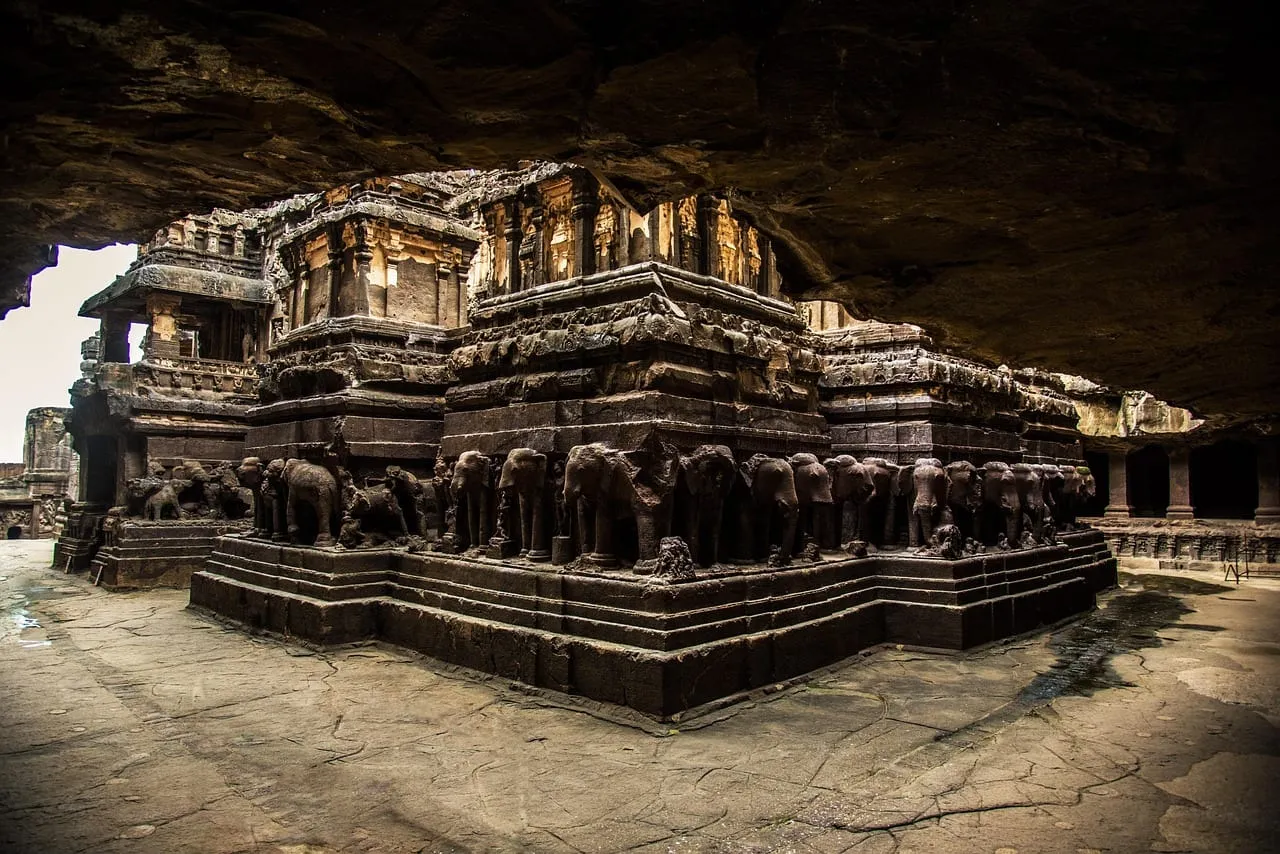
Ellora Caves
Chhatrapati Sambhajinagar, India
Buddhist, Hindu and Jain temples cut into one cliff, crowned by the Kailasa temple.
- From
- ₹550 foreigners online(€5)
- Time needed
- 3–4 hours for the main caves; 5–6 hours to see all 34 on foot

Golden Temple (Sri Harmandir Sahib)
Amritsar, India
The holiest gurdwara of the Sikhs: open day and night, free to all, with a meal for everyone.
- From
- Free
- Time needed
- 2–3 hours with the langar; come back before dawn or after dark for the Palki Sahib
 Hidden gem
Hampi
Hampi, Karnataka, India
The ruined Vijayanagara capital, scattered among giant boulders on the Tungabhadra.
- From
- ₹550 foreigners online(€5)
- Time needed
- Two full days for the main ruins; one long day covers the highlights
Before you go
The things that apply at every big sight: booking ahead, what skip-the-line really means, and the scams that follow tourists everywhere.