Hidden gem
Hampi
Hampi, Karnataka, India
ಹಂಪಿ (Hampi)
The ruined Vijayanagara capital, scattered among giant boulders on the Tungabhadra.
Checked 6 October 2026

Hampi is what is left of Vijayanagara, a 14th–16th-century royal capital whose temples, palaces and bazaars lie among granite boulders on the Tungabhadra River in Karnataka. Most of the ruins are free; one ASI ticket (₹550 online for foreigners) covers the Vittala Temple with its Stone Chariot, the Lotus Mahal and Elephant Stables. The ruins are spread over many square kilometres, so the real planning question is how you get around in the heat.
About Hampi
Hampi is the ruined heart of Vijayanagara, the capital of a Hindu empire that ruled much of southern India from 1336 until 1565. What survives spreads over about 41 km² of the Tungabhadra valley: more than a thousand structures, from vast temple complexes to stepped tanks, palace platforms, aqueducts, gateways and colonnaded market streets, all set among piles of orange granite boulders. UNESCO listed it in 1986.
Around 1500 it was one of the largest cities in the world, and Portuguese and Persian visitors wrote about its markets selling horses, gems and spices. The city grew richest under Krishnadevaraya in the early 16th century, and many of the grandest halls carry his inscriptions. In 1565, after the Battle of Talikota, an alliance of Deccan sultanates sacked the capital, and it was never rebuilt.
The site falls into two main parts. The Sacred Centre by the river has Hampi Bazaar, the Virupaksha Temple, which is still in daily worship, the hills of Hemakuta and Matanga and the riverside walk to the Vittala Temple. The Royal Centre, a few kilometres south, has the palace platforms, the Queen's Bath, the Hazara Rama Temple and the Zenana Enclosure with the Lotus Mahal and the Elephant Stables.
Hampi is also a pilgrimage place. Local tradition sets the monkey kingdom of Kishkindha from the Ramayana here, and across the river Anjanadri Hill is revered as Hanuman's birthplace. Pilgrims, Indian families, backpackers and boulderers share the place, which is busy with people even where the buildings are in ruins.
What to see
Vittala Temple and the Stone Chariot
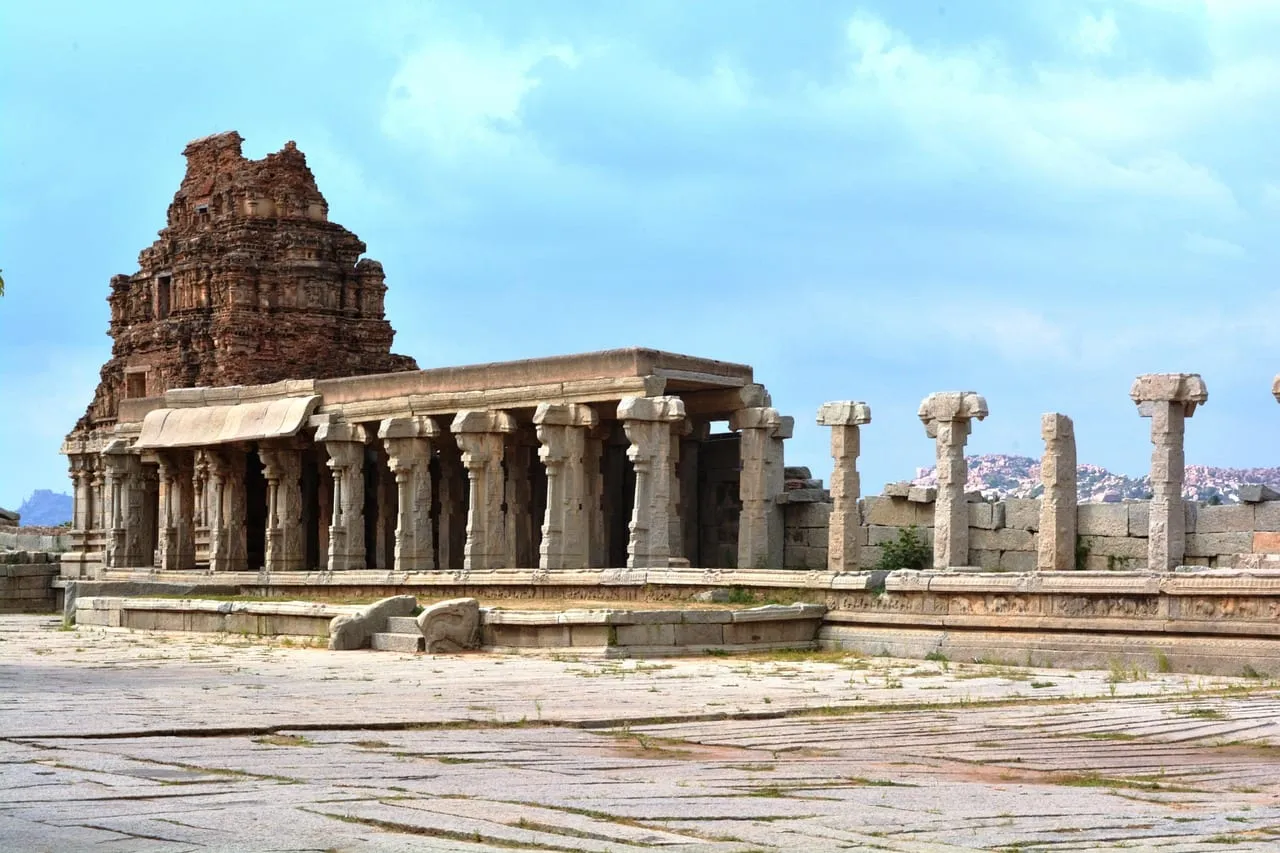
The richest temple complex in Hampi, with the Stone Chariot (the shrine to Garuda that is on India's ₹50 note) and halls of carved granite pillars. Cars and autos stop at a parking area about 1 km away; from there you walk or take the electric buggy. The 'musical pillars' may not be tapped, and parts of the main hall have been closed for ASI maintenance at times. This is the main ticketed site.
Virupaksha Temple and Hampi Bazaar
The Shiva temple at the west end of Hampi Bazaar predates the empire and is still in daily worship, with a tall gopuram over the entrance. The ruined colonnades of the bazaar street run east from it for several hundred metres. Shoes off at the entrance; a small entry and camera fee is charged by the temple, not by the ASI.
Zenana Enclosure: Lotus Mahal and Elephant Stables
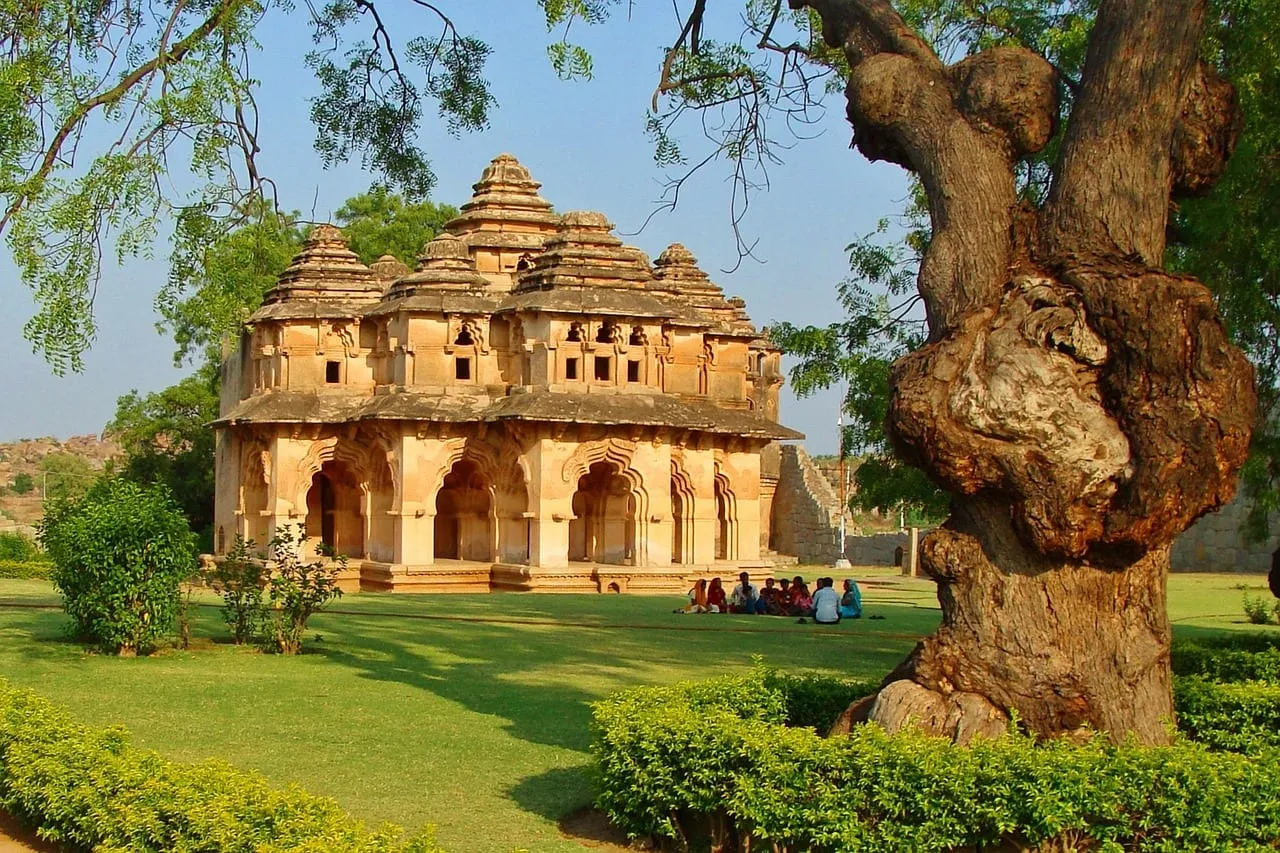
In the Royal Centre, the walled women's quarter holds the Lotus Mahal, a two-storey pavilion with arches that mix Hindu and Islamic styles, and the watchtowers. Just outside, the Elephant Stables are a row of eleven domed chambers. The same ASI ticket as the Vittala Temple covers both.
Royal Enclosure and Hazara Rama Temple
Free to enter: the Mahanavami platform with its carved friezes of processions, hunts and dancers, the stepped tank, the Queen's Bath, and the Hazara Rama Temple, whose outer walls are covered in reliefs of the Ramayana and of royal festivals. Allow two to three hours for the whole area.
Hemakuta and Matanga hills
Hemakuta Hill, right above Hampi Bazaar, has early temples, the large Sasivekalu and Kadalekalu Ganesha statues and an easy sunset view. Matanga Hill is the highest point in the centre: about 30 minutes up old stone steps to the Veerabhadra Temple, with a view over the whole site at sunrise or sunset. Both are free.
Riverside walk to the Vittala Temple
A path of about 2.5 km from Hampi Bazaar along the Tungabhadra to the Vittala Temple, past the Kodandarama Temple, the Achyutaraya Temple and its long ruined bazaar street, Sugriva's Cave and the King's Balance. It is the best way to arrive at the Vittala Temple, but there is no ticket counter at this back entrance (see Tips).
Lakshmi Narasimha monolith and the Underground Shiva Temple
On the road between the Sacred and Royal Centres: a seated Narasimha (Vishnu as man-lion) about 6.7 m high, carved from a single boulder in Krishnadevaraya's time, and a temple below ground level whose inner hall often stands in water. Both free.
Across the river: Anegundi and Anjanadri Hill
The older fortified village of Anegundi, and Anjanadri Hill with its Hanuman temple at the top of about 570 whitewashed steps. Reached by coracle or small boat when the river allows, or by road via a long detour.
Hampi tickets: which to buy and where
Buy the ASI e-ticket for 'Group of Monuments, Hampi': ₹550 for foreigners and ₹35 for Indians online, ₹600 and ₹40 at the counter. One ticket covers the Vittala Temple and the Zenana Enclosure with the Lotus Mahal and Elephant Stables, and visitors report it also covers the Archaeological Museum at Kamalapura. It is valid for the day you book. Almost everything else in Hampi is free, apart from the small temple fee at Virupaksha.
The official ticket site
Archaeological Survey of India (ASI) e-ticketing
The ASI sells tickets on asi.paygov.org.in and asi.payumoney.com (which forwards to its booking page at eticket.webfront.in/asi), where the site is listed as 'Group of Monuments, Hampi' in the Hampi circle. The QR boards at the monuments lead to the same system. Without an online ticket, you pay at the counters at the Vittala Temple and the Zenana Enclosure; carry cash.
ASI ticket, foreign visitor, online
₹550; under 15 free
(€5)
Official ticketsSkips the ticket line
- Includes
- Vittala Temple complex, Zenana Enclosure (Lotus Mahal, watchtowers) and Elephant Stables on the same day; visitors report it also gets them into the Archaeological Museum at Kamalapura (closed Fridays). Electric buggy to the Vittala Temple not included
- Best for
- Most foreign visitors: ₹50 cheaper than the counter and usable at the back entrance of the Vittala Temple, where there is no counter
ASI (official) · as of October 2026See this ticket → (opens in a new tab)ASI ticket, foreign visitor, at the counter
₹600; under 15 free
(€6)
Official ticketsDoes not skip lines
- Includes
- Same sites as the online ticket. Counters at the Vittala Temple main (east) gate and at the Zenana Enclosure
- Best for
- Visitors without card, UPI or mobile data; queues are usually short outside weekends and holidays
ASI (official) · as of October 2026See this ticket → (opens in a new tab)ASI ticket, Indian citizens, SAARC and BIMSTEC nationals
₹35 online; ₹40 at the counter; under 15 free
(under €1)
Official ticketsSkips the ticket line
- Includes
- Same sites. SAARC and BIMSTEC citizens (e.g. Nepal, Bangladesh, Sri Lanka, Thailand) pay the Indian price with proof of nationality
- Best for
- Indian nationals and visitors from neighbouring countries
ASI (official) · as of October 2026See this ticket → (opens in a new tab)Virupaksha Temple entry
small temple fee (reported between ₹2 and about ₹20 per person); camera fee extra
(under €1)
ResellerDoes not skip lines
- Includes
- The living Shiva temple at Hampi Bazaar, run by the temple authorities rather than the ASI. Not covered by the ASI ticket
- Best for
- Everyone; pay at the gate, in cash
 Temple counter (not the ASI) · as of October 2026See this ticket → (opens in a new tab)
Full-day private tour by car with guide and entry
from €127.11 per person (varies by group size)
ResellerSkips some lines
- Includes
- Pickup from hotels in Hosapete or Hampi at 8:00, private car, guide, entrance charges and lunch; Vittala, Virupaksha, Royal and Zenana Enclosures, Hazara Rama and more in about 9 hours
- Best for
- Visitors with one day who want transport, tickets and explanations sorted
 Viator (5 Senses Walks) · as of October 2026See this ticket → (opens in a new tab)
How to buy
- Go to asi.paygov.org.in (or asi.payumoney.com), choose the Hampi circle and 'Group of Monuments, Hampi', then your date, the forenoon (6:00–12:00) or afternoon (12:00–18:00) slot in which you will reach your first ticketed site, and your visitor type.
- Enter names and passport or ID numbers as on the documents you will carry, add children under 15 (free), pay by card or UPI and save the e-ticket with its QR code on your phone; mobile signal is patchy among the ruins.
- Show the QR code at the Vittala Temple gate and again at the Zenana Enclosure on the same day; visitors report it also gets them into the museum at Kamalapura. Keep your passport or ID to hand.
- Without an online ticket, pay cash at the counter by the Vittala Temple's main gate or at the Zenana Enclosure: ₹600 for foreigners, ₹40 for Indians.
- Coming on foot along the river to the Vittala Temple's back entrance? There is only a QR board there, no counter, so buy online before you set off.
Look-alike sites
Only the ASI's own portals sell the Hampi ticket: asi.paygov.org.in and asi.payumoney.com (which leads to eticket.webfront.in/asi). In April 2026 the ASI warned about fake websites selling tickets for the Taj Mahal, which uses the same portals; Hampi tickets are booked the same way. Sites with 'Hampi' or 'Hampi tickets' in the domain are information or tour sites, not ticket sellers. The price is fixed at ₹550 online for foreigners and ₹35 for Indians; any 'Hampi entry ticket' sold for more is a reseller or a tour.
We can never guarantee a ticket seller, tour company or deal. Prices, opening hours and what is included change, often without notice: check the details on the seller’s own page before you pay, and book through the official site where you can. How to avoid ticket scams · Disclaimer.
Guided tours of Hampi
Most of Hampi has no signs worth the name, so a good guide makes a real difference on the first day: they explain the carvings, the history and the Ramayana stories, and know the order that avoids the heat. Hiring a government-licensed guide for a day is cheap by European standards, and you can add an auto-rickshaw or a car. On a second day, a bicycle or scooter and a map are enough. Only private tours are sold here; there are no shared group tours with fixed departures.
Private guide only, full day
Hire a Licensed Guide for Fullday Hampi visit with own transport
Bangalore and Beyond (on Viator)A government-licensed guide meets you at the Sasivekalu Ganesha statue below Hemakuta Hill and goes with you in your own auto, car or on bikes; ends at Kamalapura. Covers Hemakuta, Virupaksha, the river, Vittala, the Royal Centre and Zenana Enclosure. Entry fees, coracle ride and transport not included. The lowest-priced full-day guide listing seen on Viator.
from €28.50 per person (varies by group size)
See this tour → (opens in a new tab)Private car tour, guide and entries optional
Hampi Heritage Hues: Uncover the Majesty of Vijayanagara Empire
Agora Voyages Pvt. Ltd. (on Viator)Air-conditioned car with driver from hotels within 15 km of Hampi, 9:00 to about 18:00: Virupaksha, Vittala, Hazara Rama, the Royal Enclosure and Lotus Mahal, the riverside, ending on Matanga Hill for sunset. Check which option you pick: the cheapest is car only.
from €57.20 per person; higher options add the guide and entry fees
See this tour → (opens in a new tab)Private full-day tour by car, all-inclusive
1 day private tour of Hampi world heritage site in car with professional guide
5 Senses Walks (on Viator)Pickup from hotels in Hosapete and Hampi at 8:00; guide, car, entry fees and lunch included. Starts at the Vittala Temple, then King's Balance, Virupaksha, the Ganesha and Narasimha monoliths, the Royal and Zenana Enclosures, Hazara Rama and the Underground Shiva Temple. English only.
from €127.11 per person (varies by group size)
See this tour → (opens in a new tab)Private day trip by car
Full Day Private Tour of Badami, Aihole and Pattadakal from Hampi
Five Senses Tours (on Viator)Not Hampi itself: a long day to the 6th–8th-century Chalukya cave temples at Badami and the temples of Aihole and Pattadakal (Pattadakal is UNESCO-listed), about 3 hours' drive each way. For a third day in the area.
from €154 per person (varies by group size)
See this tour → (opens in a new tab)
We can never guarantee a ticket seller, tour company or deal. Prices, opening hours and what is included change, often without notice: check the details on the seller’s own page before you pay, and book through the official site where you can. How to avoid ticket scams · Disclaimer.
Hampi deals and discounts
Hampi is cheap: one ₹550 ticket (online) covers all the ASI's ticketed sites for the day, and most of the ruins cost nothing. Tours cost more because of the car, the guide and lunch, not because of better entry.
Most of Hampi is free
Hemakuta and Matanga hills, Hampi Bazaar, the riverside ruins, the Achyutaraya Temple, the Royal Enclosure, the Queen's Bath, the Hazara Rama Temple and the Narasimha monolith have no ticket. You pay only at the Vittala Temple, the Zenana Enclosure and Elephant Stables, the museum and Virupaksha.
One ticket for several sites, ₹50 cheaper online
The ASI ticket covers the Vittala Temple and the Zenana Enclosure with the Lotus Mahal and Elephant Stables on the same day, and visitors report it also gets you into the museum at Kamalapura. Online it costs ₹550 for foreigners and ₹35 for Indians, against ₹600 and ₹40 at the counter.
Under-15s go free
Children under 15 enter the ASI sites free, Indian and foreign alike. Add them to the online booking.
ASI free-entry days
On a few days a year, such as World Heritage Day, the ASI waives entry at its monuments, and online sales close for those dates. The ASI announces each free-entry day separately, so check its announcements before planning around one, and expect crowds when it applies.
Best time to visit Hampi
Time of day: go to the Vittala Temple at 6:00 when the ticketed sites open, or after about 15:00, and spend the hot middle of the day indoors, at lunch or in the museum at Kamalapura (closed Fridays). Inside the temples and pavilions it stays surprisingly cool. Sunrise is best from Matanga Hill, sunset from Hemakuta Hill or Matanga.
Season: October to February is the best time, with daytime temperatures of roughly 15–30 °C. From March to May it gets very hot, up to about 40 °C, with little shade among the ruins. The monsoon (about June to September) turns the landscape green but brings high water, when the river crossings stop and the riverside ruins can flood.
Weekends and Indian holidays bring day-trippers and school groups, with a queue for the electric buggy to the Vittala Temple; weekdays are quieter. Hampi Utsav, the state's cultural festival with stages and lit-up monuments, was held on 13–15 February 2026; dates for the next edition had not been announced in October 2026, and autos and rooms cost more during it.
Tips and tricks
Gathered from travel forums, locals and the sight’s own advice, rewritten in our own words. What worked for others, not a guarantee.
Buy online before the riverside walk
If you walk to the Vittala Temple along the river from Hampi Bazaar, you arrive at the back (west) entrance, where there is only a QR board and no ticket counter. Buying there means uploading ID on your phone; otherwise it is a 1 km detour to the main gate. Buy the e-ticket in advance and keep a screenshot.
From TripAdvisor Vithala Temple Complex reviews, 2024
Walk or take the buggy from the Vittala parking area
Cars and autos stop about 1 km from the temple. Electric buggies run from the parking area to the gate; visitors reported paying about ₹20 per person in 2023–24, and on busy days the queue is long. The walk takes around 30 minutes along the old Vittala Bazaar street, past the temple tank and pavilions that the buggy passes without stopping.
From TripAdvisor Vithala Temple Complex reviews, 2023–2025
Split the sites over two days by area
Day one: the Sacred Centre on foot, from Virupaksha and Hemakuta Hill along the river to the Vittala Temple. Day two: the Royal Centre and Kamalapura by bicycle or auto. Your ticket only covers the ticketed sites on one day, so put the Vittala Temple and the Zenana Enclosure on the same day, or buy a second ticket.
From Wikivoyage Hampi, 2026; hampi.in
Check the rental zone and number plate
Bicycles cost about ₹100–150 a day, geared ones ₹150–250, scooters ₹400–600 on weekdays and more at weekends. Some shops do not allow their scooters across the river or into the southern zone, and white-plate (private) scooters can be fined at police checks; ask for a yellow or black plate. Fill up at the stations in Kamalapura or Anegundi, not from bottles, and leave a photocopy, not your passport, as a deposit.
From hampi.in bike rental guide, 2026; Wikivoyage Hampi
Fix the auto-rickshaw deal before you start
A full day by auto-rickshaw costs roughly ₹1,000–2,000 depending on season and bargaining. Agree the price, the list of sites and the finishing time before getting in. Drivers can find the sites, but they are not licensed guides.
From hampi.in auto-rickshaw guide; Wikivoyage Hampi (2023 prices)
Go up the hills in company and come down before dark
Matanga Hill takes about 30 minutes to climb, and for sunrise you start around 5:00 with a torch. There are no barriers on the steep sections and no lighting. There have been muggings at night in the past: go with other people and don't be the last one left on the summit after sunset.
From hampi.in cautions page
Dress for a working temple at Virupaksha
Virupaksha is in daily worship: cover shoulders and knees, take shoes off at the entrance, and expect a small camera fee. In 2024 the district administration introduced a dress code for worshippers at the temple, with boards at the entrance. At the Vittala Temple, which has no image in worship, shoes are allowed.
From Deccan Herald, January 2024; TripAdvisor reviews, 2024
Stay away from the water
The Tungabhadra looks calm but has strong currents and sudden depths, and there are no lifeguards; people drown here. During the monsoon, and whenever the dam upstream releases water, the coracles stop and the riverside paths can flood.
From hampi.in cautions page; Wikivoyage Hampi
Plan the museum around Friday
The ASI museum at Kamalapura, with sculptures from the site, opens 10:00–17:00 and is closed on Fridays. It is a good place to spend the hottest hours.
From hampi.in monument timings
How to get to Hampi
- By train: Hosapete (Hospet) Junction is the station for Hampi, 13 km away. From Bengaluru, the daily overnight Hampi Express (16592) leaves KSR Bengaluru at 21:50 and reaches Hosapete at 07:00; back, 16591 leaves Hosapete at 21:10 and arrives in Bengaluru at 05:50. There are also a few trains a week from Goa (Vasco da Gama) and from Hyderabad.
- From Hosapete: auto-rickshaw drivers meet the trains; expect about ₹200–300 to Hampi Bazaar and much more to the far side of the river. Cheaper: walk or take an auto to the Hosapete bus stand (about 1.5 km), where KSRTC buses leave for Hampi every 15–20 minutes for a few dozen rupees, via Kamalapura.
- By air: the nearest airport is Jindal Vijayanagar (VDY) at Toranagallu, about 35–40 km east, with domestic flights only. Hubballi is about 150 km away by road, and Bengaluru's international airport about 340 km (6–7 hours by road).
- By bus: KSRTC and private overnight buses run to Hosapete from Bengaluru, Goa and Gokarna, and some go on to Hampi itself.
- Getting around: the Sacred Centre is walkable, the rest needs wheels. Bicycles and scooters are hired around Hampi Bazaar and Kamalapura, autos by the trip or the day. Private cars stop at the Vittala parking area, about 1 km from the temple.
- Crossing the river: small boats and coracles cross from the ghat by the Virupaksha Temple to Virupapur Gadde and from near the Vittala Temple towards Anegundi. There is no fixed published fare: ask the price before you board. They leave when full, stop well before dark and stop altogether when the river is high or the dam upstream releases water. By road the trip round is about 40 km.
Scams and problems to watch for
Unofficial guides at the big sites
Men at the Vittala Temple parking area and around Virupaksha offer themselves as guides; not all are licensed, and auto drivers who 'guide' are not either. Ask to see a licence card, agree the price and length of the tour before you start, or book a licensed guide in advance.
Auto drivers at Hosapete station
Drivers may board the train before you get off and tell you there is no bus to Hampi. There are frequent buses from the Hosapete bus stand. If you take an auto, settle the fare (about ₹200–300 to Hampi Bazaar) before loading your bags, and say which side of the river you are going to.
Monkeys that snatch bags
Macaques at Hemakuta, Matanga and especially Anjanadri (Anjaneya) Hill and around Virupaksha grab bags, water bottles and food. Keep food out of sight, zip bags shut, don't feed or tease them, and let go of a snatched bag rather than fight a monkey.
Stranded across the river
Miss the last boat back from Virupapur Gadde or Anegundi and the choice is a 'special' crossing at whatever price the boatman sets, or a long and expensive auto ride round by road. Ask when the last crossing leaves when you go over, and allow more time in the monsoon months.
Unregistered homestays and isolated spots at night
After a violent attack on visitors near Sanapur Lake in March 2025, police checked unregistered homestays around Hampi. Stay in registered accommodation, go out in company after dark, and avoid isolated lakes, hilltops and riverbanks at night.
Drugs and 'herbs'
Dealers offer cannabis, especially to backpackers. It is illegal in India, and possession can lead to arrest.
Accessibility
Hampi is hard going with limited mobility. The ruins are spread over a large area, with uneven stone paths, sand, steps and steep rock, and the hills have no rails. Cars can get close to most sites in the Royal Centre and the Zenana Enclosure, where the lawns around the Lotus Mahal and Elephant Stables are flat. At the Vittala Temple the electric buggy runs from the parking area to the gate, but the courtyard is uneven and the halls have steps. The Virupaksha Temple has a level main courtyard but you go barefoot. The hills, the riverside path and the coracles are not accessible. Tour operators on Viator describe their Hampi tours as not wheelchair accessible; a private car with a driver is the most practical option. No specific discount for disabled visitors appears in the ASI price list.
Combine it with
Anegundi and Anjanadri Hill
The older fortified village across the river, with temples, a village craft scene and the Hanuman temple on Anjanadri Hill (about 570 steps). Combine by coracle when the river allows, or by scooter and car via the bridge.
Sanapur Lake
A reservoir among boulders north of the river, used for coracle rides. Go in daylight and in company.
Tungabhadra Dam
About 15 km away at Hosapete, with gardens and views over the reservoir; an easy stop on the way to an evening train.
Daroji Sloth Bear Sanctuary
About 25 km from Hampi, a rocky scrubland reserve for the Indian sloth bear, with a watchtower for spotting wildlife.
Badami, Aihole and Pattadakal
Chalukya cave temples and early stone temples (Pattadakal is UNESCO-listed) about 3 hours' drive north-west; a long day trip or an overnight stop on the way to or from Goa.

Questions people ask about visiting Hampi
How much is the entry ticket for Hampi?
Most of Hampi is free. The ASI ticket for the Vittala Temple and the Zenana Enclosure with the Lotus Mahal and Elephant Stables costs foreigners ₹550 online or ₹600 at the counter, and Indians ₹35 online or ₹40 at the counter; under-15s go free (October 2026). Virupaksha Temple charges its own small fee.
Is one ticket valid for the Vittala Temple and the Lotus Mahal?
Yes. The same ASI ticket covers the Vittala Temple complex and the Zenana Enclosure (Lotus Mahal and Elephant Stables) on the day you book, and visitors report it also covers the Archaeological Museum at Kamalapura. Keep the QR code or paper ticket, as you show it at each site.
How many days do you need in Hampi?
Two full days let you see the Sacred Centre on foot and the Royal Centre by bike or auto without rushing. One long day by car or auto covers the highlights. Add a third day for Anegundi across the river or a day trip to Badami, Aihole and Pattadakal.
What is the best time to visit Hampi?
October to February, when days are around 15–30 °C. Within a day, start at 6:00 when the ticketed sites open, rest in the middle of the day and go back out after 15:00 for sunset on Hemakuta or Matanga Hill. Avoid March–May, when it reaches about 40 °C.
How do I get from Bengaluru to Hampi?
Take the overnight Hampi Express (16592), which leaves KSR Bengaluru at 21:50 and reaches Hosapete Junction at 07:00, then an auto-rickshaw (about ₹200–300) or a local bus 13 km to Hampi. By road it is about 340 km, 6–7 hours.
Do I need a guide in Hampi?
Not to find your way, but a licensed guide on the first day makes the ruins far more interesting. A full-day private licensed guide on Viator starts at about €28.50 per person (October 2026), without transport or entry fees.
Can you still stay on Hippie Island (Virupapur Gadde)?
Not really: the guesthouses and restaurants on Virupapur Gadde were demolished in 2021. Budget stays are now in Hampi village, Sanapur, Hanumanahalli, Kadirampura and Anegundi. The boulders across the river are still the centre of Hampi's bouldering scene.
More sights in India
Amber Fort
Jaipur, India
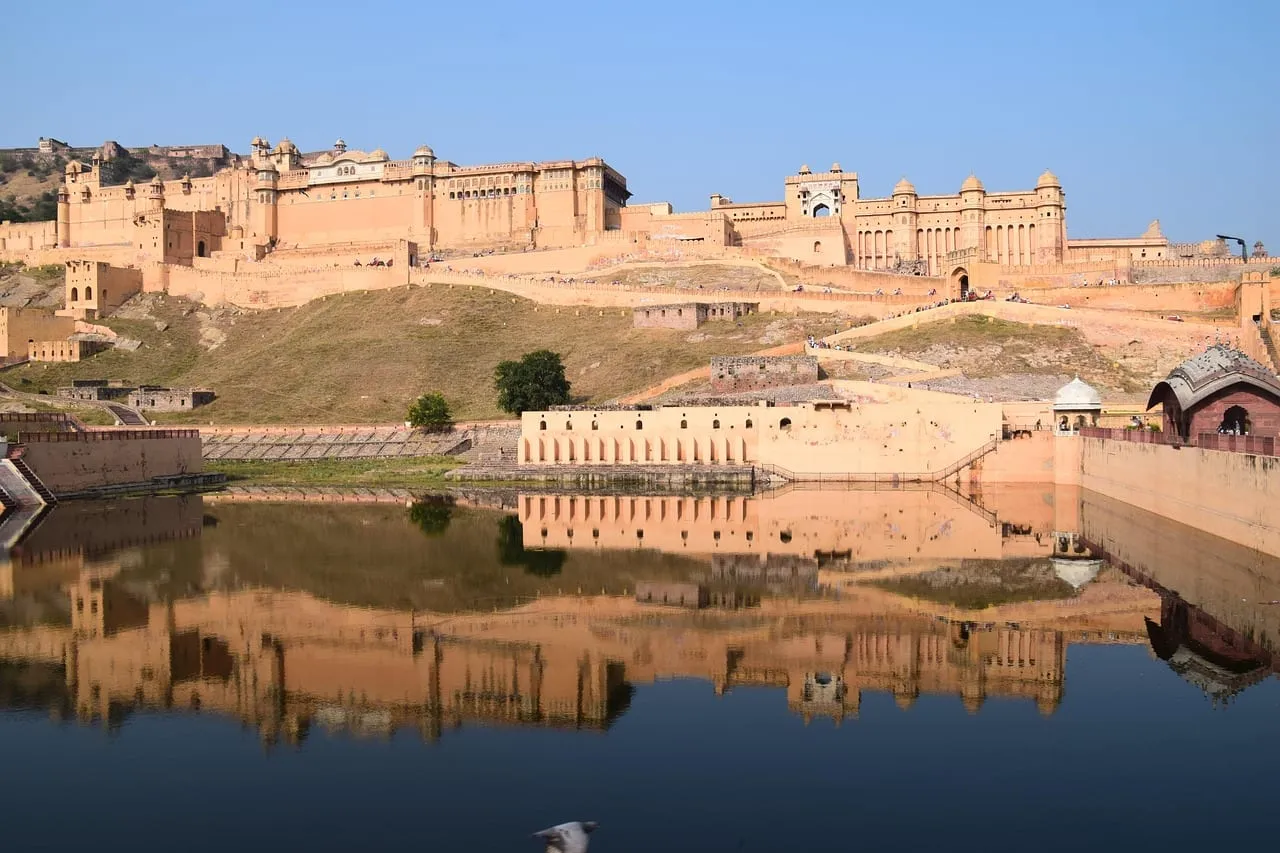
The Kachhwaha kings' hilltop palace above Maota Lake, with its famous hall of mirrors.
- From
- ₹1,000 foreigners, ₹200 Indians(€9 · €2)
- Time needed
- 2–3 hours inside; half a day with the walk up, Panna Meena ka Kund and Jaigarh
Ellora Caves
Chhatrapati Sambhajinagar, India
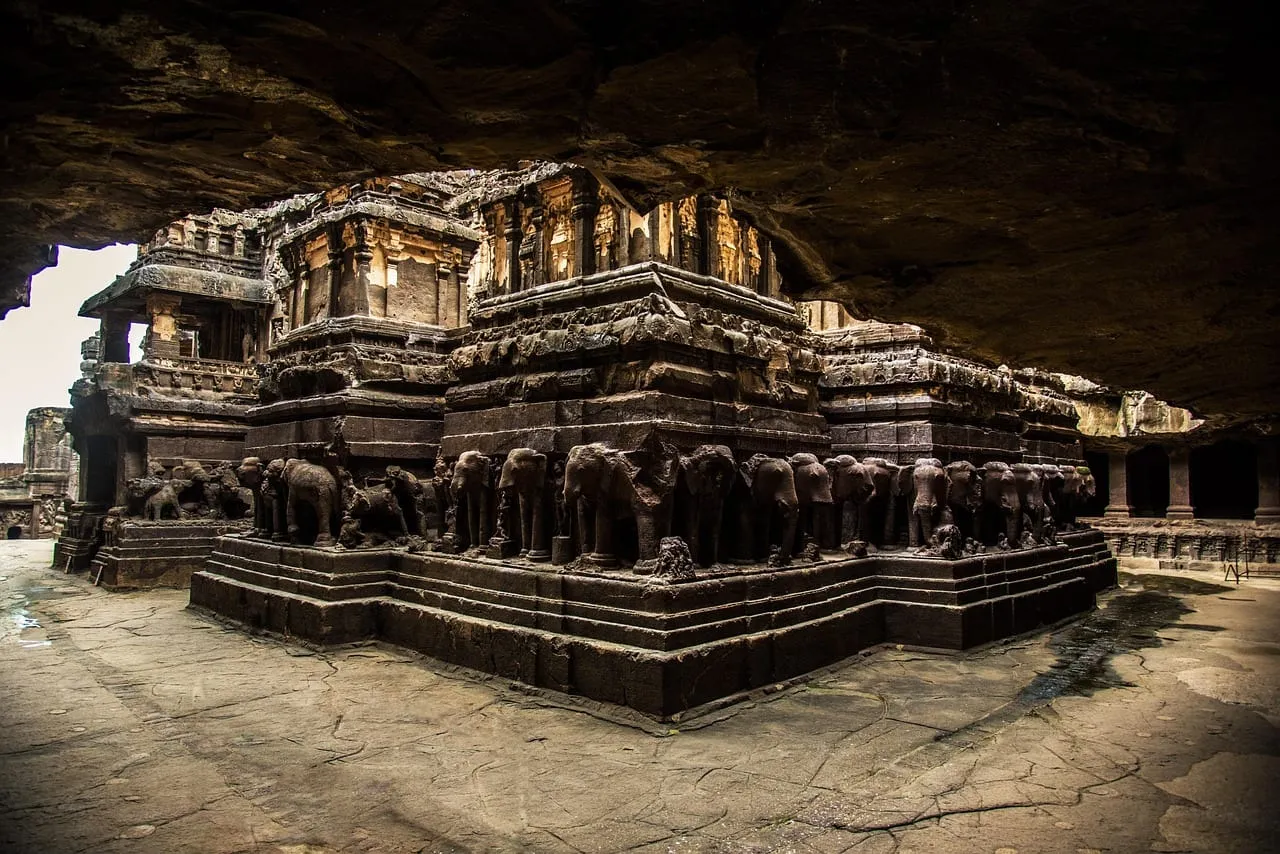
Buddhist, Hindu and Jain temples cut into one cliff, crowned by the Kailasa temple.
- From
- ₹550 foreigners online(€5)
- Time needed
- 3–4 hours for the main caves; 5–6 hours to see all 34 on foot

Golden Temple (Sri Harmandir Sahib)
Amritsar, India
The holiest gurdwara of the Sikhs: open day and night, free to all, with a meal for everyone.
- From
- Free
- Time needed
- 2–3 hours with the langar; come back before dawn or after dark for the Palki Sahib
Before you go
The things that apply at every big sight: booking ahead, what skip-the-line really means, and the scams that follow tourists everywhere.